Thursday, August 28, 2008

Besieged By Baad Smells

Besieged by bad smells

Mohammed Omer

Published 28 August 2008

The breakdown of Gaza's overworked sewage system threatens to spill over into an international ecological disaster

In Gaza, flies swarm by day and mosquitoes bite by night as an ever-present putrid smell thickens the air. The smell of sewage fermenting in the summer heat permeates everything. Gaza reeks.

Umm Hamada, 39, is unable to treat her water and can do nothing to eradicate the smell or stop insects from entering her house through the open sewage system. "When night falls and there is no electricity, it smells worse," she said. The miasma has made several of her seven children ill. Her neighbour, carrying a pyjama-clad six-year-old, pipes up: "We can't sleep, not only because of the smell, but because of the mosquitoes."

Sewage management first became a problem for Gaza in 1967, when Israel invaded and occupied the Gaza Strip. The occupation forces constructed three new sewage treatment facilities to serve the population of 380,000 people: one in Beit Lahiya, one near Gaza City, and a third near Rafah, which consists primarily of a treatment lagoon and is incapable of processing the bulk of sewage it receives. In nearby Khan Younis, septic tanks remain the primary waste treatment method, but they are prone to flooding and failure.

During the 1980s, Israel added a handful of treatment lagoons and small sewage processing stations. Established at a fraction of the capacity needed for the rapidly growing and increasingly dense population, they were quickly rendered obsolete. In 2008, these ageing facilities remain, overburdened by a 400 per cent increase in population.

Israel's frequent attacks on Gaza, and its moratorium on imports since the election of Hamas in January 2006, have further debilitated the overworked system. Parts fail and cannot be replaced. Ponds overflow, pipes burst and machines break down - and sewage overflows into streets and homes and on to Gaza's beaches. In several areas, the sea is opaque with the black deposits of untreated sewage.

Many in Gaza fear the beaches, where sewage pours on to the Mediterranean coast at a rate of between 30,000 and 50,000 cubic metres of partially treated waste water and 20,000 cubic metres of raw sewage a day.

"What ends up in the sea is the water normally reclaimed for agricultural purposes upon proper treatment," says Monther Shoblak, an engineer and director of Gaza's Coastal Municipalities Water Utility. "Gaza's power woes have exacerbated the situation. After Israel destroyed the main electricity station in 2006, when we are able to generate electricity, it is pumping sewage away from homes that takes priority. This leaves little for treatment."

Today, tide pools and aquatic life continue to deteriorate. As the raw waste settles on the ocean floor it seeps into Gaza's aquifer, contaminating further the area's already overtaxed source of drinking water. "Ninety per cent of Gaza's drinking water is considered polluted under the international standards specified by the World Health Organisation," says Shoblak.

Given time, the contamination will leak over into both Israel and Egypt. This will become an international, rather than a local, ecological, human and economic problem. It's a man-made disaster, unnecessary and wholly solvable.

Umm Hamada does not know how long she will have to wait for the stench of sewage to clear. It may be her grandchildren who live to enjoy the smell of fresh air. (source)

Wednesday, August 27, 2008

A Fresco In Gaza

Program/Issue
Amount (US Dollars)
$
Receive timely news, informative articles and commentary from around the globe.

A Fresco in Gaza

BY ALBANA DWONCH | August 22, 2008

Country: West Bank/Gaza

Topic: Peaceful Change

It came to no surprise to those who know him that the evening after he joined a young couple in Holy Matrimony in Seattle, Father Bruno Segatta traded in his priestly vestments with a pair of jeans and a t-shirt, shoved a ticket into a half-empty backpack and set off toward a much different destination: the embattled Gaza Strip.

In between absolving and anointing, baptizing and marrying, this 66-year-old priest is above all committed to celebrating the most important emotion of all: unconditional love for his fellow human beings.


"Padre Bruno" is an Italian native who has practiced painting and art since earning his degree from Northridge University in 1982, mostly at Gonzaga University's campus in Florence. He has traveled the world around with his young students, teaching them not only about art but also about compassion and caring. Revenue from paintings sold on his website, http://www.brunoartforkids.com/, is donated to the Niambani House for Kids orphanage in Nairobi, Kenya.

Even on this trip, the use of art as a therapeutic tool is at the core of his mission: to teach Palestinian youth to use art as a tool for change. "I was offered an opportunity to help other human beings that are in dire need for hope and compassion in their life," explains Bruno. "I said yes to it."

Part of the "inclusivity fresco" painted by Palestinian students in Gaza under the direction of Italian painter and humanitarian Bruno Segatta. Photo: Albana Dwonch/Mercy Corps

Bruno came as a guest of Mercy Corps' Middle East youth exchange program, "Why Not?", or "Laysh la" in Arabic. The project connects 500 Palestinian youth in Gaza and the West Bank with their U.S. peers at high schools in the American Northwest. It's a way to build bridges between two often-misunderstood cultures and to give the Palestinian youth an outlet to creatively express the hardships of living amid daily violence and oppression.

His first stop: Jerusalem, where he bought canvasses, brushes, paints. Second stop: Eretz Terminal, the often-dangerous crossing that connects Gaza with Israel. He walked through the same long, windy, impersonal tunnel that connects the two checkpoints, and emerged on the other side of the tall cement wall. After introducing himself to the taxi driver with a quick "Ciao, I am Bruno," he rode to Mercy Corps' Gaza City office, gazing out at a surreal environment: destroyed buildings, old cars sputtering along on cooking oil and a worn-down look of a place under near-constant siege.

In addition to this athlete, Gaza students drew a fishermen fishing the sun out of the sea, a column of Palestinian houses topped with a beach umbrella, and an olive tree sprouting from ruins. Photo: Albana Dwonch/Mercy Corps

Bruno arrived with two concrete objectives: to give painting lessons to eight groups of Palestinian students (130 in all) and to help 100 students paint a wall 50 meters long and 2.5 meters high at Al Aqsa University on the theme of inclusivity.

He climbed up on a ladder and divided the wall on 100 squares. Than he instructed to his Palestinian students: think, paint and enjoy. There were few rules; one was that no black color be used. Each of the squares, Bruno explained, should be seen as windows that together would show "Gaza in colors."

At first, the scale of the painting seemed impossible. "But Bruno told them, 'We can do it together' — and they did it," said Nour Al Bassy, a project coordinator with Mercy Corps.

"I wanted all of them to be part of something that they themselves would create," he explained later. Slowly, under a sweltering sun, pictures, images and colors started to emerge.

Most of the images, unsurprisingly, were centered on the separation wall. A horse jumping over the wall was the mural's most obvious window. But other drawings included a fishermen fishing the sun out of the sea, a column of Palestinian houses topped with a beach umbrella, and an olive tree sprouting from ruins.

They were simple images, but also "creative, hopeful and original," said Father Bruno.

I've rarely seen teenagers so full of energy and mirth as these were during their 10 days with Father Bruno. Their respect for the man was obvious in their smiles and their words. "'Use your mind. Think before you paint.' I will never forget that from Bruno," said 17-year-old Mohammed.

While students carried away a picture of a hardworking and always-smiling Bruno, all covered in paint, Bruno put his mental picture of the students to paper. He gave each student a copy. At the bottom of each, he wrote: "I will never forget your beautiful faces."

Beautiful to him, of course, because they are all human.

For more information the Why Not? project, visit the GloPAL Lounge on the Global Citizen Corps website.

Source

Arab Americans at the DNC, Majid Al Bahadli is Giving it His All

Below is an article written by Dr. James Zogby about Arab American participation at the DNC since 1984.

What he doesn't mention in the article he wrote, nor does the caption under the picture give, is the name of the WONDERFUL Obama delegate from the state of Washington who won more delegate votes than any other delegate who ran. He is Majid Al-Bahadli, born and raised in Iraq, now a proud HARD-WORKING Iraqi American delegate, the ONLY Iraqi-born delegate at either convention this year.

There happens to be another picture of Majid also which was one of the top emailed photos today.

Be SURE to read about Majid on his delegate page and look for him at the convention. His story is BEYOND inspiring.

Majid, this one's for you DEAR friend, I am so blessed to have gotten to know you, I am sure you are working HARD at the convention after working SO hard for so long.

If anyone reading here wants one of Majid's pins, Arab Americans for Obama (in English or a different one in Arabic) or one of his peace pins, in Hebrew and Arabic, contact him at baghdadii@comcast.net. A friend of mine and I were able to pass out over two hundred of them and they even went with us on our trip to Manzanar with CAIR.

Hang in there Majid!! You're right where you belong!!!

We got our start in San Francisco

James Zogby, Correspondent

  • Last Updated: August 26. 2008 10:26PM UAE / August 26. 2008 6:26PM GMT

More than 40 Arab-Americans are participating in this year's Democratic National Convention in Denver. Justin Sullivan / Getty Images / AFP

This week, more than 40 Arab-Americans are participating as delegates and members of standing committees to the Democratic National Convention in Denver. Here is a look back at past conventions that helps trace their progress in US politics.

1984, San Francisco

It was the first time that Arab-Americans, as an organised community, participated in a national political campaign. Prior to 1984, there had been Syrian and Lebanese committees, but never before had there been an Arab-American committee.

The Rev Jesse Jackson, recognising the potential voting strength of Arab-Americans, reached out to the community and Arab-Americans responded, raising money, working as volunteers and voting. But the process was still new to many, and so by convention time, only four Arab-Americans were there as delegates.

At the convention, Mr Jackson asked me to deliver one of the speeches placing his name in nomination for the office of president. Having grown up in a political home, and having watched every convention on television since 1956, I was overwhelmed by the experience of mounting the podium and addressing the delegates. Since I was to be the first Arab-American to speak at a convention, I began my remarks, “I am an Arab-American …”

1988, Atlanta

After four years of mobilisation, Arab-Americans went to Atlanta with more than 50 delegates and convention committee members. During the primaries, Arab-Americans made their mark as a voting bloc, helping Mr Jackson win a surprise victory in the Michigan primary.

At the same time, working together with progressive Jewish-Americans and other Jackson delegates, Arab-Americans succeeded in passing resolutions in 10 states calling for Palestinian rights, and had, through the efforts of the Jackson campaign, won the right to introduce a “minority plank” at the convention calling for “mutual recognition, territorial compromise and self determination for both Israelis and Palestinians”.

Once again, I had the opportunity to address the convention, while the 1,200 Jackson delegates demonstrated on the floor, carrying signs that read “Palestinian Statehood Now” and “Israeli Security, Palestinian Justice”.

One delegate was Mary Lahaj, of Massachusetts, who was the first Arab-American Muslim woman delegate to any convention.

1992, New York

Arab-Americans were represented by more than 40 delegates and committee members. We initially had some frustration getting into the Clinton campaign. At the convention, I ran into an American Israel Public Affairs Committee official, who said to me: “I know you’re trying to get in. We won’t let you in, and why should we?”

I was furious, but remembered Mr Jackson’s words of wisdom: “The biggest threat you pose is not to get angry and leave, but to stick around and fight.” And so we did. With the help of Ron Brown, the then-chairman of the party, and Joseph Lieberman, a senator, the doors of the campaign were opened.

That year, a resolution passed by one of the convention’s standing committees, called for inclusion and representation of Arab-Americans at all levels in the party.

1996, Chicago

Arab-Americans were represented, once again by more than 40 delegates.

The Arab-American Democratic Leadership Council was formally recognised by the Democratic Party, and Arab-Americans had become founding members of the Democrats’ Ethnic Council.

2000, Los Angeles

By now, Arab-Americans had become a fixture in the party. Once again 40-plus delegates had been elected from across the country. The Arab-American Tribute Reception was attended by more than 1,000 delegates and guests. The partisan debate within the community was intense, but it was fascinating, because this was the first time that both Republican and Democratic candidates actively courted the community’s support.

2004, Boston

With almost 50 Arab-American delegates and committee members, it was the largest delegation since 1988.

The response from party officials and elected officials at the Convention Gala was significant, with more than 50 senators and representatives confirming their attendance at both that event and the issues forum, Civil Liberties and Global Responsibility.

2008, Denver

Once again there are more than 40 Arab-American participants at every level. I am convening the Party’s Ethnic Council and chairing its two caucus meetings, and Mary Rose Oakar is the chairman of the convention rules committee.

Marking new firsts for Arab-Americans, the Barack Obama campaign has hired an Arab-American outreach staff person in all-important Michigan, and the campaign has launched the first Arab-Americans page on its official website. A formal launch of Arab Americans for Obama, chaired by Nick Rahall, a congressman from West Virginia, is to take place next month.

What was remarkable in 1984, has now become commonplace in 2008.

Tuesday, August 19, 2008

Going out of Town

Will be back in a week, August 25th.


"The Carnival is Over"
Dead Can Dance

Outside
The storm clouds gathering,
Moved silently along the dusty boulevard.
Where flowers turning crane their fragile necks
So they can in turn
Reach up and kiss the sky.

They are driven by a strange desire
Unseen by the human eye
Someone is calling.

I remember when you held my hand
In the park we would play when the circus came to town.
Look! over here.

Outside
The circus gathering
Moved silently along the rainswept boulevard.
The procession moved on the shouting is over
The fabulous freaks are leaving town.

They are driven by a strange desire
Unseen by the human eye.
The carinval is over.

We sat and watched
As the moon rose again
For the very first time.

Monday, August 18, 2008

Celebrate Mahmoud Darwish in Glendale, August 30, 2008

http://cache.daylife.com/imageserve/02XN2gn9993RQ/610x.jpg


Palestine Aid Society

Invites you to a

Celebration of the Life and Works

of

Palestinian Poet and Hero

Mahmoud Darwish

1941 – 2008

Saturday, August 30, 2:00 p.m.

Glendale Public Library Auditorium

222 E. Harvard St., Glendale 2nd Floor

Dr. Nabil Azzam will premier his new composition
"Elegy for Mahmoud Darwish"

Comments by:
Historian Dr. Mahmood Ibrahim, Cal Poly Pomona
Professor Gabriel Piterberg, UCLA
Professor Hamoud Salhi, CSUD
Professor Bice Harris, Occidental College
Rev. Darrel Meyers
Donald Bustany of KPFK's "Middle East In Focus"
and many more
Poetry Readings by:
Egyptian-American actor/activist Nasser Faris
Hip-Hop stars Nizar ("Ragtop") Wattad
and Omar ("Offendum") Chakaki
Program in English
Admission Free

Fortune Cookies and Other Hasbara Brain Farts

Every once in while you come across an article that makes you fall off the chair laughing. Such is the case with an article published in JPost, "Pro-Israel fortune cookies, other hasbara ideas touted by student fellowship". BTW: I'm laughing because of a run in I had with these folks last year when they so OBNOXIOUSLY tried to disrupt an event at which Hedy Epstein spoke. Reading that they are trying to come up with hasbara ideas like pro-Israeli fortune cookies makes me CRACK UP when they behave in such a manner! (Not to mention the manner in which Israel behaves which I REALLY don't think fortune cookies are going to do the trick to change people's poor impression of) It begins:

Think out of the box, was the message former consul general to New York, Alon Pinkas, had last week for a group of 150 international university students who were graduating from a hasbara fellowship program.

The student activists, who spent the summer learning about Israel advocacy from the StandWithUs organization based in Los Angeles and Jerusalem, presented Pinkas with six potential projects chosen out of 140 proposals. They included putting pro-Israeli messages inside fortune cookies and making a YouTube video promoting Israel, but Pinkas, who praised their energy and initiative, was intentionally blunt with the groups, preparing them for the harsher world of diplomacy.

While he said the students had done "a brilliant job," he added that all of their ideas had been tried before by the Foreign Ministry and failed.


So is Pinkas saying Israel has baked up fortune cookies before and they didn't work? Not only fortune cookies, but be stated that all these ideas are OLD ideas, and none of them worked!

LOLOLOL, (sometimes one has to supplement horror with humor), I WONDER WHY?

Could it possibly be that the world is waking up, that fortune cookies and nearly nude female Israeli soldiers aren't doing the trick?

MAYBE if they put all the IOF soldiers to work in bakeries making fortune cookies and took them OUT of the occupied territories where they commit daily crimes against the Palestinian people, THAT might work.

Yes "Stand With Us", fortune cookies just might work after all!!!

MySpace Comments

Fortune Cookie Generator at CommentsJunkie.com


Marching in the 68th Annual Nisei Parade!


Yesterday I had the honor and the FUN of marching in the 68th annual Nisei Parade in Little Tokyo, Los Angeles. I marched with my dear friends from NCRR (Nikkei Civil Rights and Redress who successfully won reparations from our government to all those of Japanese decent who were interred in concentration camps in WWII)

We first assembled at Centenary Methodist Church at 3:30 to prepare for the parade to begin.
As it turned out, NCRR was marching almost at the end of the parade so we had to wait til six to begin marching, but that was actually fine because we could get to the corner where the participants merged in to start marching to see them as they began. We had munched on beautiful trays of fruits and drank cool lemonade at Centenary which refreshed us before marching.

The sidewalks of Little Tokyo were lined with people who cheered and clapped giving peace signs as we marched by with Kathy, Richard and Lillian riding in a convertable in front of us. Parade rules stated no political banners so we weren't able to carry our banner for Ehren Watada but he was right there with us in all our thoughts. (NCRR handles his core campaign for the LA area), NCRR had some other really nice banners made which NCRR members carried, colorful and tall stating what NCRR stands for, REDRESS, PEACE and JUSTICE. There were about 20-25 of us who marched, waving and giving peace signs back to the onlookers.

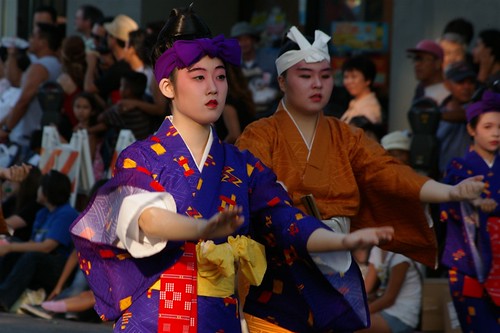
It was so much fun! There were some floats carrying the "courts" this year's and last's as well as other's carrying taiko drummers. A traditional Japanese sailboat carried the band Hiroshima (remember THIS song?). There were dancers who danced the route in beautiful traditional costumes. Banning High School sent their marching band and drill team (who gave us all inspiration to walk in straight rows!) as well as the Long Beach Junior Concert Band(picture above-of their-what would you call it?)-sign on wheels-which the band has been pushing in parades for 40 years!)

At the end of the parade we all went back to Centenary Church for a meal they had prepared for all the "dignitary" participants who were gathered there. Noodles, tempura, sushi, traditional desserts as well as mochi ice cream, YUM!) Mike Murase made some fantastic tee-shirts for Obama, black with Obama written in Japanese lettering, then "change" below, YES we all need some change).

This whole week Little Tokyo is hosting the Nisei week festival. Check out their website to see all the educational and fun things to do!

Blogdowntown has an article with some beautiful pictures too!

Little Tokyo's Nisei Week Marches On

By Ed Fuentes
Published: Monday, August 18, 2008, at 09:21AM
catching light Ed Fuentes

Color and tradition highlight Little Tokyo's Nisei Week Japanese Festival.

Even with without a Tofu Festival being held this year, and no Nebuta float, the annual Nisei Week went forward as it has for 68 years. Saturday's events included a relocated car show held where the Nikkei Center––better known as the Mangrove site––is slated to be built at First and Alameda.

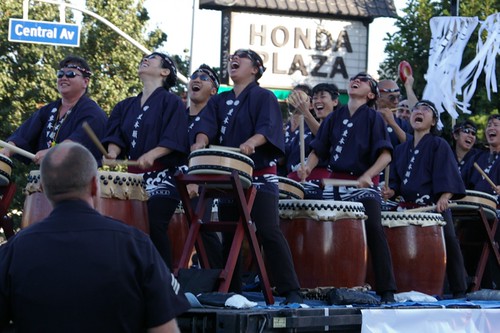
Late Sunday afternoon, the Grand Parade had traditional dancers, floats, bands and civic dignitaries marched on Second street (from Central) to Los Angeles St, then turning on to First before circling back on to Central. The Nisei Week Japanese Festival continues this week, ending Sunday, August 24, with the Ondo Community Dance Celebration and Closing Ceremony at 4pm.

end of route Ed Fuentes

At the end of the parade route, these drummers screamed in unison to mark the end of their trip around Little Tokyo.

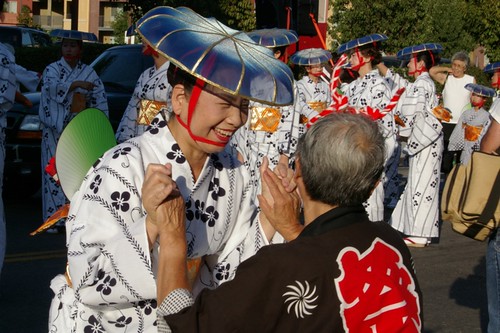
greet Ed Fuentes Nisei Week was begun by Little Tokyo residents to celebrate a cultural heritage. Through the years, it's also become a community reunio

Saturday, August 16, 2008

Where Have All the Poems Gone?

Poetry.

With the death a week ago of beloved Palestinian poet, Mahmoud Darwish, it comes of little surprise (but a smile across my face) that while we here in America are more concerned with texting on our Blackberries, the Arab world has been immersed in watching a program on television in the same vein as American Idol only this program is a contest between poets.

It always utterly amazes me that Americans have NO clue about the depth of intellectuality in the Arab world, no clue whatsoever, probably because this is a lost endeavor for the masses in America, content with sound-bite biased news programming while in schools the social sciences and the emphasis on writing skills have been placed on the back burner in the pursuit of raising math and science scores due to the requirements of the No Child Left Behind Act.

Just now I stopped at the local Albertsons (super market) to pick up some cinnamon rolls. Just like at Fresh and Easy they now have a fast do-it-yourself check out lane where you scan your purchases and the touch computer screen tells you what to do next. I wasn't quite sure how this one worked so an employee, a middle aged very attractive female employee came over to help me. I said to her, "This is so Orwellian" to which she responded, "What's that?"

I said, "You know, it refers to George Orwell who wrote "1984" and how in the future so many human touches will be lost and other things too".

She responded, "I don't know about that, who's that?"

I looked at her and said, "You've never heard of George Orwell?"

"No" she responded.

I was so taken back I almost didn't know what to say, but just said, "Well, if you have a computer at home, you should look him up to learn a little bit about him"

There you go, I told her to use her computer.

Everything is becoming "quick". Not that long ago I would have told her she should go to the local library and check out one of his books, but do people even read any more?

I don't know, but on the other side of the world, people are writing and reciting poetry, and the people there are glued to their televisions watching and listening.

Just something to think about.

All are princes, says winning poet

Tala al Ramahi

  • Last Updated: August 16. 2008 9:48PM UAE / August 16. 2008 5:48PM GMT

“In the end, I believe it is the poet’s manners – how he deals with people on a daily basis – that makes him a real prince”: Mr Weld Bamba upon winning the title and its Dh1 million prize. Galen Clarke / The National

ABU DHABI // Four months ago there were 7,000 hopefuls. They were whittled down to 35 and, after 10 weeks of intense competition, to just six until, on Thursday night, when the “Emirate of Poets” finally crowned its prince, there was just one.

In the final upset of a series that has held viewers spellbound, the Mauritanian poet, Seedi Mohammed Weld Bamba, emerged as the unexpected victor in the last episode of one of the largest televised cultural competitions in the world. His success was witnessed by a television audience of more than two million.

The finale of the second season of Prince of Poets, the hit television project of the Abu Dhabi Authority for Culture and Heritage, was filled with unexpected twists and surprises – just as the Egyptian Ahmed Bekheit, the favourite among the finalists, had suggested it would be.

And not least among those surprises was the last-minute upset for Bekheit, who found himself relegated to third place.

The most prolific of the finalists, Bekheit, 42, already had 14 published collections of poetry to his name, including four for children, and was consistently the panel’s favourite, receiving rave reviews from the five judges throughout the competition.

The Algerian Khalidiyah Gaballah, 28, the only remaining female finalist, was voted off at the beginning of the show and the surviving five had to recite a poem they had written recounting their experiences during the competition.

For his final poem, dedicated to the memory of the Palestinian poet Mahmoud Darwish, who died on Aug 9 following bypass surgery, Bekheit received a loud and long round of applause and one of only two standing ovations of the night.

Bekheit’s name had barely been announced in third place when the crowd at the Al Raha Beach Theatre – mostly Mauritanians – exploded with joy, waving their green and white national flags and cheering and screaming at the realisation that the most likely candidate for the title had been eliminated – and that their man Bamba was now in with a good chance of winning.

And win he did.

As his name was announced at 2am on Friday morning, the crowd showed a great deal more emotion than Bamba. The Al Jazeera producer, who is also working on his master’s degree in international journalism through a distance-learning programme at Goldsmiths University, London, remained a picture of composure.

“In the end, I believe it is the poet’s manners – how he deals with people on a daily basis – that makes him a real prince,” he said. “And therefore, the title bears the poet with the responsibility to represent all the other poets of the Arab world, in a positive way, I hope.

“The prince of poets needs to be a poet with his words, but also a poet through his deeds.”

Despite the harsh critiques he had received from the panelists throughout the past nine weeks, Bamba was clearly the audience’s favourite and won 68 per cent of the viewers’ votes – and, in the end, the Dh1 million (US$272,000) first prize.

Running a close second and third were Mohammed Ibrahim Yacoub from Saudi Arabia and Bekheit, who received Dh500,000 and Dh300,000 respectively. Prizes of Dh200,000 and Dh100,000 went to Jordanian Mohannad Sari and Adi Weld Adab, the second Mauritanian finalist, in fourth and fifth place.

The show’s organisers said that more than three million people from the Arab world, as well as Europe and America, had taken part in the voting.

The victory celebrations were in contrast to the sombre mood throughout most of the three-and-a-half-hour show, conducted in a muted tone as judges, poets and audience alike honoured the memory of Darwish.

A moment of silence was observed and a poem written by one of the judges, Dr Ali bin Tamim, was recited before the start of the programme. “We would like to console the Arab world and those who fought for human rights for their loss of a great poet,” said Dr Tamim.

Darwish, said competitor Sari, was “the real Prince of Poets of our generation”, before reciting a poem in memory of the Palestinian, in addition to the one he had written for the competition.

Bamba also dedicated his poem to the memory of Darwish and a final poem was recited collectively by the 35 contestants who had qualified for the show nine weeks before.

At the end, the newly crowned Prince of Poets lived up to his own expectations of a poet as a prince in word and deed, and had some gracious words for his fellow competitors, who had joined him on stage, carrying the Mauritanian flag, for his moment of triumph.

“I really believe that the other five finalists are all princes,” he said, “not only in their poetry, but also in their demeanour and in their contributions to our culture and our craft.” (source)

Friday, August 15, 2008

IOF Looks the Other Way in the Occupied Territorories

SOURCE: The zionist occupation of Hebron, Palestine has made life a living hell for the Palestinians who are the rightful owners of this land.

The crazy jewish women in this video is Yifat Alkobi, who continually harassed the Abu 'Ayesha family and other families in this area.

Please see:

http://www.btselem.org/English/

For more information on this video, and documentation of other human rights violations in occupied Palestine.

B'TSELEM is the Israeli Information Center For Human Rights In the Occupied Territories.

Another incident involving Yifat Alkobi:

Alkobi is well known to Hebron police for her alleged attack of a 10-year-old Palestinian child in March 2005, for which she is to go on trial February 1. The boy, Yusuf Aza, told investigators from the human rights organization Yesh Din that he was walking on the path between his home and Alkobi's with two friends, when she began pelting him with stones. Aza added that Alkobi "grabbed me by the shirt and pushed me up against the wall. A soldier tried to help, but she pushed him away, and he fell down. She held me with one hand and with the other pushed a rock into my mouth and forced my mouth closed. I felt my teeth breaking." Aza said the soldier got up and called for help on his radio.

(To my knowledge, this woman has never been punished for her crimes.)


Israel 'worry' at settler attacks


Screen grab of Israeli settler about to beat Palestinian civilian
One recent incident was captured on film as part of a human rights project

Israeli security officials are reported to have raised concerns about an increase in violence by Jewish settlers in the West Bank.

The Israeli Haaretz newspaper said officials had found an increase in incidents of settlers causing harm to Palestinians and to Israeli soldiers.

There were 429 incidents in the first half of 2008, against 551 in 2007.

There are frequent reports of settlers harassing Palestinians, with two attacks recently captured on video.

These have been widely broadcast and have brought the issue to greater prominence.

Haaretz said police, army and security services had also discussed allegations that some police and soldiers were deliberately ignoring violence by settlers against Palestinians, because they preferred not to get involved in difficult issues.

Settlement withdrawal delayed

In July, an Israeli rights group published a report saying nine out of 10 investigations into alleged attacks on Palestinians by Israeli settlers ended without anyone being charged.

The Yesh Din group said that, of 163 cases that it looked at, only 13 had ended with assailants being indicted.

Israeli police disputed the findings, but admitted just 15% of cases in the West Bank in 2007 ended in a charge.

And Israeli officials have said their priorities in the West Bank are to deal with terrorism against Israelis as well as criminal and public order offences, and resources are allocated accordingly.

Meanwhile, the Israeli defence ministry has said Israel has postponed the expected evacuation of the settlement of Migron, in the West Bank. No new date has been set.

Migron has a population of about 200, and is the largest of about 100 Jewish settlements established without Israeli government permission.

All settlements in the West Bank are considered illegal under international law, though Israel disputes this.

There are thought to be around 430,000 Jewish settlers living in the West Bank, including East Jerusalem. (Source)


CAMERA Is Saying There Is No Palestine, AGAIN

The ever ready indefatigable zionist CAMERA (Committee for "Accuracy" in Middle East Reporting in America) is at it again. This time, their latest blog post concerns the NBC Olympics website where Palestine is listed as a country. It's a short post titled "NBC Olympics Web Site Awards West Bank to “Palestine”

There is currently no state of Palestine, and no international border between Israel and Judea and Samaria (aka West Bank). The borders and territory of any future Palestinian entity are disputed. However, the NBC Olympics Web Site includes a map showing Judea and Samaria (the West Bank, along with with the Gaza Strip) as part of a country called “Palestine.” Conversely, a map of Israel is shown minus that territory. In other words, NBC mapmakers are playing political arbiters and have awarded the disputed territory to the Palestinians.

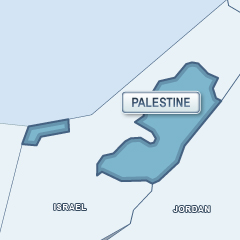
The Palestine country page shows:

PLE.jpg

The Israel country page shows:

ISR.jpg

_____________________________________________________________


Now, let's go to the NBC Website and see what it REALLY says concerning Palestine( which as you will read, is not flattering to Palestine, blaming the Palestinians for the lack of transition to statehood, but that isn't sufficient to CAMERA, NO, they have to say there's NO SUCH THING as Palestine, it is instead, "Judea and Samaria, typical Eretz Israel Zionist lexicon)

Often called the "Holy Land." A historic region of southwest Asia between the eastern Mediterranean shore and the Jordan River, comprising parts of modern Israel, Jordan, and Egypt. Israel has handed most of the Gaza Strip and seven West Bank population centers to Palestinian rule under a process set in motion by the historic Israel-PLO peace deal in 1993.

In the late 1990s, the PLO and Israel agreed to expand The Palestine Liberation Organization (PLO), headed by Yasser Arafat, was founded in 1964 and is recognized by the United Nations as the government of the Palestinians. After a three-year hiatus, negotiations to determine the future of the Gaza Strip and the West Bank began in September 1999 but were cut off in September 2000 after violence broke out in both regions.

In April 2003, United Nations, European Union, United States and Russian officials announced the "Road Map to Peace," which outlined the steps that Israel and Palestinian authorities would have to take to achieve peace - including the creation of an independent Palestinian state - by 2005. The path was stymied along the way, as Palestinian authorities were unable to stop anti-Israeli terrorism and Israel's military struck back against Palestinians with force. But in 2005, all Israeli settlers were evacuated from the Gaza Strip and control was transferred to the Palestinian Authority.

_____________________________________________________

Let's see what the NBC Olympics website has to say about Israel:

Located at the eastern end of the Mediterranean Sea and is bordered to the west by Egypt, to the east by Syria and Jordan, and to the north by Lebanon. Proclaimed its independence in 1948 as the state of Israel.


_____________________________________________________

Maybe CAMERA is just upset because there is more written on the Palestine page even if it isn't flattering then there is on the Israel page!

CAMERA wrote, "no international border between Israel and Judea and Samaria"

What is that HUGE apartheid wall all about then? Oh yes, it's a border on one side, walling the Palestinians in and appropriating their lands seeking to establish "facts on the ground" in any possible future peace deal, but it is ONE WAY border which Israel controls. But it IS a border which Israel CLAIMS as a "security fence" and an ILLEGALLY built one also. Israel's OWN recent "peace offer" "gives" the land on the OTHER side of the apartheid wall to the PALESTINIANS. (sarcasm concerning "gives" intended)

Maybe CAMERA would be happier with a current more detailed map of the West Bank with all the ILLEGAL Israeli settlements there!
_______________________________________________________

Now, just in case anyone from the eager beaver CAMERA comes to visit, they might want to know something concerning PALESTINE'S participation in the Olympics. On my prior post, "Palestine's Olympic Team", I was asked the following in my comment section by "William"

I thought only countries were able to enter teams in the Olympics? Palestine is not a country. How are they able to enter the Olympics? Are there any other non-countries participating in this way?


My response:

Hi William,
Here's the answer to your question:

Palestine was so excited about the possibility of competing in the Olympics that a Palestinian Olympic Committee was one of the first things established after the late Palestinian leader Yasser Arafat and Israeli Prime Minister Yitzhak Rabin signed a peace agreement on the White House lawn in October 1993. Even though the Palestinian National Authority (PNA) is not a state, its status as an independent territory makes it eligible for the Olympics. For years, Israel blocked any recognition of “Palestine” arguing it was not a sovereign nation, yet non-sovereign nations like Puerto Rico, for example, which is an American territory, have a tradition of participation, Ray Hanania wrote in Mideast Youth (http://www.mideastyouth.com) on August 9.
http://www.palestine-pmc.com/det...p?cat=1& id=1958

They first participated in 1996 in Atlanta and have sent athletes to each summer Olympics since.

_________________________________________________

CAMERA, please go back to the NBC Olympics site and check out Puerto Rico! They are listed under COUNTRIES with their OWN FLAG and PAGE! WITH the explanation just like the page for Palestine gives.

So wasn't that a whole lot of huffing and puffing for NOTHING? Or maybe you have a beef with NBC over Puerto Rico too! (and for Israel's recent "peace offering" "giving" the land on the OTHER side of the apartheid wall to PALESTINE-of course with major settlement blocks they insist on keeping which "gives" the Palestinians a swiss cheese state still at Israel's "mercy".)
_____________________________________________________

OH MY GOODNESS CAMERA, I think you need to contact the US Department of State concerning the map they have of Israel! They don't have the West Bank marked as Palestine, but they certainly don't have it marked as Israel either, JUST LIKE as you wrote on your blog concerning the NBC map, "Conversely, a map of Israel is shown minus that territory. AND for the purposes of the map for the NBC website, they were giving a map of the area-the West Bank (and Gaza) which the PALESTINIAN Olympic team represents.

Look closely at the State Department's map, they have a "*" next to "West Bank" stating, "Israeli OCCUPIED with current status subject to the Israeli Palestinian interim agreement"


Israel map and flag


Huff and puff til you blow your own house down CAMERA! PALESTINE is participating in the Olympics and accusing NBC of being "mapmakers (are) playing political arbiters is a WEE bit of a stretch.

And just in case you haven't seen, here are two beautiful pictures of PALESTINE'S Olympic team carrying THEIR flag.

Palestine, may you SOON be FREE!

[palestine.jpg]

[Palestine2.jpg]


Thursday, August 14, 2008

Drinking the Poisoned Waters of Gaza

I have a friend who as an independent journalist traveled to Gaza last year. We were speaking on the phone last night and she told me about a high incident of a type of anemia in the Gaza Strip and that the necessary medications are not getting in. She knew about this because while there she visited the Ministry of Health and a hospital where she saw patients suffering from this.

The below article is a new study out by scientists who have done a study on the drinking water in Gaza writing for a specialist journal, Science of the Total Environment.

First, from the Department of Health, New South Wales:

What is methaemoglobinaemia?

Methaemoglobinaemia is a very rare blood disorder where the blood is unable to carry oxygen to cells in the body. The condition occurs when normal haemoglobin, which is found inside red blood cells, is changed to abnormal haemoglobin, called methaemoglobin.

What are the symptoms

Symptoms of methaemoglobinaemia include:

  • headache
  • weakness
  • nausea and vomiting
  • diarrhoea
  • increased heart rate
  • breathlessness
  • skin turning blue (called cyanosis)
  • loss of consciousness.

In severe cases, the disease can be fatal. Symptoms usually occur rapidly after being exposed to some toxic substances.

What causes methaemoglobinaemia?

Methaemoglobinaemia is caused when a person is exposed to some poisons, including some types of drugs. Chemicals called nitrites have been known to cause methaemoglobinaemia after consumption. Rarely, some people have a genetic defect that causes the disease.

How is it diagnosed?

A person suffering methaemoglobinaemia is often very unwell. A blood test is needed to confirm the diagnosis. It is important that this condition is diagnosed early and treated promptly.

How is it treated?

Methaemoglobinaemia is treated using oxygen therapy and an antidote called methylene blue. People suffering with methaemoglobinaemia can make a full recovery with prompt treatment. (but Gaza doesn't have the supplies of oxygen they need)

What can be done to avoid methaemoglobinaemia?

Outbreaks of methaemoglobinaemia have occurred when people have eaten food that has been contaminated with high levels of nitrites. People should not add any chemicals to food if they are uncertain of the ingredients. (source)

______________________________

Drinking Water In Gaza Strip Contaminated With High Levels Of Nitrate

ScienceDaily (Aug. 14, 2008) — Palestinian and German scientists have recommended to the authorities in the Gaza Strip that they take immediate measures to combat excessive nitrate levels in the drinking water.

90 per cent of their water samples were found to contain nitrate concentrations that were between two and eight times higher than the limit recommended by the World Health Organization (WHO), say the researchers from the University of Heidelberg and the Helmholtz Centre for Environmental Research (UFZ) writing in the specialist journal Science of the Total Environment.

Over the long term they recommend that the best protection would be provided by quality management for groundwater resources. Groundwater is the only source of drinking water for the majority of people living in the Gaza Strip. In babies younger than six months, nitrate can lead to methaemoglobinaemia, to diarrhoea and to acidosis. The WHO therefore recommends keeping nitrate levels to 50 milligrams per litre or less.

According to unpublished research, half of the 640 infants tested were already showing signs of methaemoglobinaemia. The new Palestinian-German study confirms earlier water analyses and is the first study to pinpoint a source of the contamination. With the help of isotope analyses, the researchers were able to demonstrate that the nitrate pollution can be traced back to manure used in farming and to wastewater.

With over 2600 people per square kilometre, the Gaza Strip is one of the most densely populated areas on earth. Because of their isolation, the inhabitants of this area between the Mediterranean, Egypt and Israel are reliant on being self-sufficient. The fields are mostly fertilized with chicken and cow dung. Artificial fertilizers account for only around a quarter of the fertilizer used.

Because of the area’s geology and the semi-arid climate, it is fairly easy for impurities to seep down from the surface into the aquifier system. Organic fertilizers and wastewater are the main causes of the nitrate contamination in the groundwater, followed by sewage sludge and artificial fertilizers.

This was revealed by the isotope ratios of nitrogen (15N/14N) and oxygen (18O/16O) in the nitrate. Isotopes are variations of the same chemical element that have a different number of neutrons in their nuclei. 18O and 15N are stable, i.e. non-radioactive, isotopes that are heavier than "normal" oxygen (16O) or nitrogen (14N) and can therefore be measured using a mass spectrometer.

"The lower 15N nitrogen isotope values in the sewage sludge indicate that the nitrate in the Gaza groundwater comes primarily from manure used as fertilizer," explains Dr Karsten Osenbrück of the UFZ. Between 2001 and 2007 the scientists took water samples from 115 municipal wells and 50 private wells on seven occasions. They measured nitrate concentrations of between 31 and 452 milligrams per litre. Only 10 of the 115 municipal wells examined were found to have a nitrate level below the WHO guideline value. The situation with the private wells was equally serious: apart from three, all the wells were found to have nitrate levels that were between five and seven times higher than the WHO recommendations. (source)

Wednesday, August 13, 2008

Let's Look Back at Putin's Speech in Munich for Clues

I originally posted this speech in February 2007 right after Putin delivered it. Everyone looking at the situation in Georgia now should take the time to read this rather lengthy speech to see the message he was sending back then, that the world needs to wake up to the fact that no one power can act unilaterally (such as what the US has been doing, particularly under George Bush with his administration's arrogance).

One must note that Georgia has been seeking NATO membership by becoming a client state of the US while building a growing military trained by both the US and Israel. Lost to many who listen to the MSM is the fact that Georgia lobbed the first volley in the current fighting. Tim Brunero writes in his article. "Russian Invasion Not Quite as it Seems":

"With the West sucking up to Georgia of late and vice-versa (Georgia has the third biggest contingent of foreign troops in Iraq) the government in Tblisi may have thought Russia would be wary enough to sit back and watch it reclaim the province. (South Ossetia) They were wrong.

Instead Russia chose to send a powerful message not only to restless ethnic groups like the Chechens on the fringes of their own country, but also to surrounding countries with large Russian minorities – all 25 million of them.

At the same time it showed the toothlessness of NATO and perhaps the folly of its eastward expansion into countries previously in the sphere of influence of Moscow.

In some ways, the West’s attempt to humiliate Russia by aggressively recruiting so close to its borders may have backfired and shown what a paper tiger they represent.

The Russian bear was not dead, but in hibernation."


Now to Putin's speech from last year which should have been a harbinger to how Russia/Putin may have chosen to react should they be challenged in such a manner.

Full Text of Putin's Speech in Munich

Everyone is buzzing about Putin's speech, and while the media covered what it deemed the "contraversial" statements, it did not cover the other important informational aspects of his speech which can only be found in the full text below:


Speech at the 43rd Munich Conference on Security Policy
02/10/2007

(The speech was held in Russian. Find the English translation below.)

Thank you very much dear Madam Federal Chancellor, Mr Teltschik, ladies and gentlemen!

I am truly grateful to be invited to such a representative conference that has assembled politicians, military officials, entrepreneurs and experts from more than 40 nations.

This conference’s structure allows me to avoid excessive politeness and the need to speak in roundabout, pleasant but empty diplomatic terms. This conference’s format will allow me to say what I really think about international security problems. And if my comments seem unduly polemical, pointed or inexact to our colleagues, then I would ask you not to get angry with me. After all, this is only a conference. And I hope that after the first two or three minutes of my speech Mr Teltschik will not turn on the red light over there.

Therefore. It is well known that international security comprises much more than issues relating to military and political stability. It involves the stability of the global economy, overcoming poverty, economic security and developing a dialogue between civilisations.

This universal, indivisible character of security is expressed as the basic principle that “security for one is security for all”. As Franklin D. Roosevelt said during the first few days that the Second World War was breaking out: “When peace has been broken anywhere, the peace of all countries everywhere is in danger.”

These words remain topical today. Incidentally, the theme of our conference – global crises, global responsibility – exemplifies this.

Only two decades ago the world was ideologically and economically divided and it was the huge strategic potential of two superpowers that ensured global security.

This global stand-off pushed the sharpest economic and social problems to the margins of the international community’s and the world’s agenda. And, just like any war, the Cold War left us with live ammunition, figuratively speaking. I am referring to ideological stereotypes, double standards and other typical aspects of Cold War bloc thinking.

The unipolar world that had been proposed after the Cold War did not take place either.

The history of humanity certainly has gone through unipolar periods and seen aspirations to world supremacy. And what hasn’t happened in world history?

However, what is a unipolar world? However one might embellish this term, at the end of the day it refers to one type of situation, namely one centre of authority, one centre of force, one centre of decision-making.

It is world in which there is one master, one sovereign. And at the end of the day this is pernicious not only for all those within this system, but also for the sovereign itself because it destroys itself from within.

And this certainly has nothing in common with democracy. Because, as you know, democracy is the power of the majority in light of the interests and opinions of the minority.

Incidentally, Russia – we – are constantly being taught about democracy. But for some reason those who teach us do not want to learn themselves.

I consider that the unipolar model is not only unacceptable but also impossible in today’s world. And this is not only because if there was individual leadership in today’s – and precisely in today’s – world, then the military, political and economic resources would not suffice. What is even more important is that the model itself is flawed because at its basis there is and can be no moral foundations for modern civilisation.

Along with this, what is happening in today’s world – and we just started to discuss this – is a tentative to introduce precisely this concept into international affairs, the concept of a unipolar world.

And with which results?

Unilateral and frequently illegitimate actions have not resolved any problems. Moreover, they have caused new human tragedies and created new centres of tension. Judge for yourselves: wars as well as local and regional conflicts have not diminished. Mr Teltschik mentioned this very gently. And no less people perish in these conflicts – even more are dying than before. Significantly more, significantly more!

Today we are witnessing an almost uncontained hyper use of force – military force – in international relations, force that is plunging the world into an abyss of permanent conflicts. As a result we do not have sufficient strength to find a comprehensive solution to any one of these conflicts. Finding a political settlement also becomes impossible.

We are seeing a greater and greater disdain for the basic principles of international law. And independent legal norms are, as a matter of fact, coming increasingly closer to one state’s legal system. One state and, of course, first and foremost the United States, has overstepped its national borders in every way. This is visible in the economic, political, cultural and educational policies it imposes on other nations. Well, who likes this? Who is happy about this?

In international relations we increasingly see the desire to resolve a given question according to so-called issues of political expediency, based on the current political climate.

And of course this is extremely dangerous. It results in the fact that no one feels safe. I want to emphasise this – no one feels safe! Because no one can feel that international law is like a stone wall that will protect them. Of course such a policy stimulates an arms race.

The force’s dominance inevitably encourages a number of countries to acquire weapons of mass destruction. Moreover, significantly new threats – though they were also well-known before – have appeared, and today threats such as terrorism have taken on a global character.

I am convinced that we have reached that decisive moment when we must seriously think about the architecture of global security.

And we must proceed by searching for a reasonable balance between the interests of all participants in the international dialogue. Especially since the international landscape is so varied and changes so quickly – changes in light of the dynamic development in a whole number of countries and regions.

Madam Federal Chancellor already mentioned this. The combined GDP measured in purchasing power parity of countries such as India and China is already greater than that of the United States. And a similar calculation with the GDP of the BRIC countries – Brazil, Russia, India and China – surpasses the cumulative GDP of the EU. And according to experts this gap will only increase in the future.

There is no reason to doubt that the economic potential of the new centres of global economic growth will inevitably be converted into political influence and will strengthen multipolarity.

In connection with this the role of multilateral diplomacy is significantly increasing. The need for principles such as openness, transparency and predictability in politics is uncontested and the use of force should be a really exceptional measure, comparable to using the death penalty in the judicial systems of certain states.

However, today we are witnessing the opposite tendency, namely a situation in which countries that forbid the death penalty even for murderers and other, dangerous criminals are airily participating in military operations that are difficult to consider legitimate. And as a matter of fact, these conflicts are killing people – hundreds and thousands of civilians!

But at the same time the question arises of whether we should be indifferent and aloof to various internal conflicts inside countries, to authoritarian regimes, to tyrants, and to the proliferation of weapons of mass destruction? As a matter of fact, this was also at the centre of the question that our dear colleague Mr Lieberman asked the Federal Chancellor. If I correctly understood your question (addressing Mr Lieberman), then of course it is a serious one! Can we be indifferent observers in view of what is happening? I will try to answer your question as well: of course not.

But do we have the means to counter these threats? Certainly we do. It is sufficient to look at recent history. Did not our country have a peaceful transition to democracy? Indeed, we witnessed a peaceful transformation of the Soviet regime – a peaceful transformation! And what a regime! With what a number of weapons, including nuclear weapons! Why should we start bombing and shooting now at every available opportunity? Is it the case when without the threat of mutual destruction we do not have enough political culture, respect for democratic values and for the law?

I am convinced that the only mechanism that can make decisions about using military force as a last resort is the Charter of the United Nations. And in connection with this, either I did not understand what our colleague, the Italian Defence Minister, just said or what he said was inexact. In any case, I understood that the use of force can only be legitimate when the decision is taken by NATO, the EU, or the UN. If he really does think so, then we have different points of view. Or I didn’t hear correctly. The use of force can only be considered legitimate if the decision is sanctioned by the UN. And we do not need to substitute NATO or the EU for the UN. When the UN will truly unite the forces of the international community and can really react to events in various countries, when we will leave behind this disdain for international law, then the situation will be able to change. Otherwise the situation will simply result in a dead end, and the number of serious mistakes will be multiplied. Along with this, it is necessary to make sure that international law have a universal character both in the conception and application of its norms.

And one must not forget that democratic political actions necessarily go along with discussion and a laborious decision-making process.

Dear ladies and gentlemen!

The potential danger of the destabilisation of international relations is connected with obvious stagnation in the disarmament issue.

Russia supports the renewal of dialogue on this important question.

It is important to conserve the international legal framework relating to weapons destruction and therefore ensure continuity in the process of reducing nuclear weapons.

Together with the United States of America we agreed to reduce our nuclear strategic missile capabilities to up to 1700-2000 nuclear warheads by 31 December 2012. Russia intends to strictly fulfil the obligations it has taken on. We hope that our partners will also act in a transparent way and will refrain from laying aside a couple of hundred superfluous nuclear warheads for a rainy day. And if today the new American Defence Minister declares that the United States will not hide these superfluous weapons in warehouse or, as one might say, under a pillow or under the blanket, then I suggest that we all rise and greet this declaration standing. It would be a very important declaration.

Russia strictly adheres to and intends to further adhere to the Treaty on the Non-Proliferation of Nuclear Weapons as well as the multilateral supervision regime for missile technologies. The principles incorporated in these documents are universal ones.

In connection with this I would like to recall that in the 1980s the USSR and the United States signed an agreement on destroying a whole range of small- and medium-range missiles but these documents do not have a universal character.

Today many other countries have these missiles, including the Democratic People’s Republic of Korea, the Republic of Korea, India, Iran, Pakistan and Israel. Many countries are working on these systems and plan to incorporate them as part of their weapons arsenals. And only the United States and Russia bear the responsibility to not create such weapons systems.

It is obvious that in these conditions we must think about ensuring our own security.

At the same time, it is impossible to sanction the appearance of new, destabilising high-tech weapons. Needless to say it refers to measures to prevent a new area of confrontation, especially in outer space. Star wars is no longer a fantasy – it is a reality. In the middle of the 1980s our American partners were already able to intercept their own satellite.

In Russia’s opinion, the militarisation of outer space could have unpredictable consequences for the international community, and provoke nothing less than the beginning of a nuclear era. And we have come forward more than once with initiatives designed to prevent the use of weapons in outer space.

Today I would like to tell you that we have prepared a project for an agreement on the prevention of deploying weapons in outer space. And in the near future it will be sent to our partners as an official proposal. Let’s work on this together.

Plans to expand certain elements of the anti-missile defence system to Europe cannot help but disturb us. Who needs the next step of what would be, in this case, an inevitable arms race? I deeply doubt that Europeans themselves do.

Missile weapons with a range of about five to eight thousand kilometres that really pose a threat to Europe do not exist in any of the so-called problem countries. And in the near future and prospects, this will not happen and is not even foreseeable. And any hypothetical launch of, for example, a North Korean rocket to American territory through western Europe obviously contradicts the laws of ballistics. As we say in Russia, it would be like using the right hand to reach the left ear.

And here in Germany I cannot help but mention the pitiable condition of the Treaty on Conventional Armed Forces in Europe.

The Adapted Treaty on Conventional Armed Forces in Europe was signed in 1999. It took into account a new geopolitical reality, namely the elimination of the Warsaw bloc. Seven years have passed and only four states have ratified this document, including the Russian Federation.

NATO countries openly declared that they will not ratify this treaty, including the provisions on flank restrictions (on deploying a certain number of armed forces in the flank zones), until Russia removed its military bases from Georgia and Moldova. Our army is leaving Georgia, even according to an accelerated schedule. We resolved the problems we had with our Georgian colleagues, as everybody knows. There are still 1,500 servicemen in Moldova that are carrying out peacekeeping operations and protecting warehouses with ammunition left over from Soviet times. We constantly discuss this issue with Mr Solana and he knows our position. We are ready to further work in this direction.

But what is happening at the same time? Simultaneously the so-called flexible frontline American bases with up to five thousand men in each. It turns out that NATO has put its frontline forces on our borders, and we continue to strictly fulfil the treaty obligations and do not react to these actions at all.******

I think it is obvious that NATO expansion does not have any relation with the modernisation of the Alliance itself or with ensuring security in Europe. On the contrary, it represents a serious provocation that reduces the level of mutual trust. And we have the right to ask: against whom is this expansion intended? And what happened to the assurances our western partners made after the dissolution of the Warsaw Pact? Where are those declarations today? No one even remembers them. But I will allow myself to remind this audience what was said. I would like to quote the speech of NATO General Secretary Mr Woerner in Brussels on 17 May 1990. He said at the time that: “the fact that we are ready not to place a NATO army outside of German territory gives the Soviet Union a firm security guarantee”. Where are these guarantees?

The stones and concrete blocks of the Berlin Wall have long been distributed as souvenirs. But we should not forget that the fall of the Berlin Wall was possible thanks to a historic choice – one that was also made by our people, the people of Russia – a choice in favour of democracy, freedom, openness and a sincere partnership with all the members of the big European family.

And now they are trying to impose new dividing lines and walls on us – these walls may be virtual but they are nevertheless dividing, ones that cut through our continent. And is it possible that we will once again require many years and decades, as well as several generations of politicians, to dissemble and dismantle these new walls?

Dear ladies and gentlemen!

We are unequivocally in favour of strengthening the regime of non-proliferation. The present international legal principles allow us to develop technologies to manufacture nuclear fuel for peaceful purposes. And many countries with all good reasons want to create their own nuclear energy as a basis for their energy independence. But we also understand that these technologies can be quickly transformed into nuclear weapons.

This creates serious international tensions. The situation surrounding the Iranian nuclear programme acts as a clear example. And if the international community does not find a reasonable solution for resolving this conflict of interests, the world will continue to suffer similar, destabilising crises because there are more threshold countries than simply Iran. We both know this. We are going to constantly fight against the threat of the proliferation of weapons of mass destruction.

Last year Russia put forward the initiative to establish international centres for the enrichment of uranium. We are open to the possibility that such centres not only be created in Russia, but also in other countries where there is a legitimate basis for using civil nuclear energy. Countries that want to develop their nuclear energy could guarantee that they will receive fuel through direct participation in these centres. And the centres would, of course, operate under strict IAEA supervision.

The latest initiatives put forward by American President George W. Bush are in conformity with the Russian proposals. I consider that Russia and the USA are objectively and equally interested in strengthening the regime of the non-proliferation of weapons of mass destruction and their deployment. It is precisely our countries, with leading nuclear and missile capabilities, that must act as leaders in developing new, stricter non-proliferation measures. Russia is ready for such work. We are engaged in consultations with our American friends.

In general, we should talk about establishing a whole system of political incentives and economic stimuli whereby it would not be in states’ interests to establish their own capabilities in the nuclear fuel cycle but they would still have the opportunity to develop nuclear energy and strengthen their energy capabilities.

In connection with this I shall talk about international energy cooperation in more detail. Madam Federal Chancellor also spoke about this briefly – she mentioned, touched on this theme. In the energy sector Russia intends to create uniform market principles and transparent conditions for all. It is obvious that energy prices must be determined by the market instead of being the subject of political speculation, economic pressure or blackmail.

We are open to cooperation. Foreign companies participate in all our major energy projects. According to different estimates, up to 26 percent of the oil extraction in Russia – and please think about this figure – up to 26 percent of the oil extraction in Russia is done by foreign capital. Try, try to find me a similar example where Russian business participates extensively in key economic sectors in western countries. Such examples do not exist! There are no such examples.

I would also recall the parity of foreign investments in Russia and those Russia makes abroad. The parity is about fifteen to one. And here you have an obvious example of the openness and stability of the Russian economy.

Economic security is the sector in which all must adhere to uniform principles. We are ready to compete fairly.

For that reason more and more opportunities are appearing in the Russian economy. Experts and our western partners are objectively evaluating these changes. As such, Russia’s OECD sovereign credit rating improved and Russia passed from the fourth to the third group. And today in Munich I would like to use this occasion to thank our German colleagues for their help in the above decision.

Furthermore. As you know, the process of Russia joining the WTO has reached its final stages. I would point out that during long, difficult talks we heard words about freedom of speech, free trade, and equal possibilities more than once but, for some reason, exclusively in reference to the Russian market.

And there is still one more important theme that directly affects global security. Today many talk about the struggle against poverty. What is actually happening in this sphere? On the one hand, financial resources are allocated for programmes to help the world’s poorest countries – and at times substantial financial resources. But to be honest -- and many here also know this – linked with the development of that same donor country’s companies. And on the other hand, developed countries simultaneously keep their agricultural subsidies and limit some countries’ access to high-tech products.

And let’s say things as they are – one hand distributes charitable help and the other hand not only preserves economic backwardness but also reaps the profits thereof. The increasing social tension in depressed regions inevitably results in the growth of radicalism, extremism, feeds terrorism and local conflicts. And if all this happens in, shall we say, a region such as the Middle East where there is increasingly the sense that the world at large is unfair, then there is the risk of global destabilisation.

It is obvious that the world’s leading countries should see this threat. And that they should therefore build a more democratic, fairer system of global economic relations, a system that would give everyone the chance and the possibility to develop.

Dear ladies and gentlemen, speaking at the Conference on Security Policy, it is impossible not to mention the activities of the Organisation for Security and Cooperation in Europe (OSCE). As is well-known, this organisation was created to examine all – I shall emphasise this – all aspects of security: military, political, economic, humanitarian and, especially, the relations between these spheres.

What do we see happening today? We see that this balance is clearly destroyed. People are trying to transform the OSCE into a vulgar instrument designed to promote the foreign policy interests of one or a group of countries. And this task is also being accomplished by the OSCE’s bureaucratic apparatus which is absolutely not connected with the state founders in any way. Decision-making procedures and the involvement of so-called non-governmental organisations are tailored for this task. These organisations are formally independent but they are purposefully financed and therefore under control.

According to the founding documents, in the humanitarian sphere the OSCE is designed to assist country members in observing international human rights norms at their request. This is an important task. We support this. But this does not mean interfering in the internal affairs of other countries, and especially not imposing a regime that determines how these states should live and develop.

It is obvious that such interference does not promote the development of democratic states at all. On the contrary, it makes them dependent and, as a consequence, politically and economically unstable.

We expect that the OSCE be guided by its primary tasks and build relations with sovereign states based on respect, trust and transparency.

Dear ladies and gentlemen!

**In conclusion I would like to note the following. We very often – and personally, I very often – hear appeals by our partners, including our European partners, to the effect that Russia should play an increasingly active role in world affairs.

In connection with this I would allow myself to make one small remark. It is hardly necessary to incite us to do so. Russia is a country with a history that spans more than a thousand years and has practically always used the privilege to carry out an independent foreign policy.

We are not going to change this tradition today. At the same time, we are well aware of how the world has changed and we have a realistic sense of our own opportunities and potential. And of course we would like to interact with responsible and independent partners with whom we could work together in constructing a fair and democratic world order that would ensure security and prosperity not only for a select few, but for all.

Thank you for your attention.


http://www.securityconference.de/konferenzen/rede.php?menu_presse=&menu_2007=&menu_konferenzen=&sprache=en&id=179&
Munich Conference on Security Policy

"Walks in the West Bank"

Watch the VIDEO

View the beautiful SLIDE SHOW

Read the article in the New York Times

"Roaming Freely in a Land of Restraints"

IDF Murderers: Be They Innocent and Proud

Not surprisingly Israel has cleared the IDF in the deaths of Reuter's camerman Fadel Shana and eight others who were struck by fire and murdered from an Israeli tank in April. When was the last time we witnessed Israel bringing to justice ANY of their IDF soldiers when either killing or wounding Palestinians?

Today in the LA Times the following article was published, "Crime and Israeli Army Punishment" concerning the point blank shooting of Ashraf Abu Rahmeh. (video of the incident can be seen HERE)

In the Israeli military, injuring a handcuffed Palestinian is 'conduct unbecoming' a soldier -- but less so than tying cardboard wings to an antenna.
By Etgar Keret
August 13, 2008
Afew weeks ago, I saw a short news interview of a man who killed his wife with a kitchen knife. "Are you sorry for what you did?" the interviewer asked, and the murderer shrugged and said, "A little." His answer was only two short words, but they contained a ton of subtext. As if the murderer had said, "OK, I accept the fact that slaughtering my wife in front of my kids wasn't really right, but to handcuff me for it, to take me to court and send a TV crew? Don't you think you're overdoing it a little?"

An Israeli military court last week held a hearing about an incident captured on videotape that allegedly shows a regiment commander holding a bound, blindfolded Palestinian man, arrested at a demonstration, while a soldier shoots a rubber bullet at his leg. There is some disagreement between the soldier and the officer as to whether the soldier was ordered to do so. The two were indicted on the charge of conduct unbecoming to members of the Israeli army. The prosecution apparently is not even seeking any prison time, and some reports say that a plea bargain is likely.

There are many charges that could be brought against soldiers and commanders who fire at a handcuffed detainee, and the army's choice of conduct unbecoming carries the same tone as the statement made by the man who murdered his wife: We don't think it's really right to shoot at a handcuffed detainee who poses no threat. But, guys, let's keep things in perspective. The bullet was rubber, not steel; the kid didn't die, he was just wounded; and let's not forget that we're talking here about a pain-in-the-neck demonstrator and not someone strolling innocently along the beach promenade eating ice cream.

Years ago, when I was still in high school, my older brother was brought up on the charge of conduct unbecoming to a soldier in Israel. During one of his guard-duty shifts, out of boredom, he decorated the antenna he was guarding with huge cardboard wings and a sharp-featured face, turning it into a totem pole. His commander, who showed up for a surprise inspection, claimed that he found my brother worshiping the antenna.

Because there is no way the Israeli Defense Forces can prosecute a soldier for paganism, my brother was charged with conduct unbecoming and found guilty. Unlike the soldier and officer who were involved in a shooting, my brother actually did find himself in the brig for 30 days.

In retrospect, there is no doubt that it would have been better for my brother to relieve his boredom by shooting bound detainees. Because shooting bound detainees is not only more exciting and entertaining, it is also -- so it turns out -- a much less serious offense. After all, although both acts are conduct unbecoming, there is some kind of scale, and the IDF system of punishment testifies to it: Tying huge cardboard wings to an antenna is conduct unbecoming, but shooting at a bound person is also conduct unbecoming, but less so. Or, to use the language of the man who killed his wife, "Conduct a little unbecoming for a soldier in the IDF."

Etgar Keret is the author of, most recently, "The Girl on the Fridge and Other Stories." This essay was translated from Hebrew by Sondra Silverston. (source)


The following is the response from Reuters concerning the murder of their cameraman and eight others:

FACTBOX: Death of Reuters Gaza cameraman

Wed Aug 13, 2008 8:39am EDT
var showComments = false; var allowSLCall = false; /** START SITELIFE INTEGRATION **/ if( self == top ) { var re = /\/article/; var articleExist = top.document.location.href.match(re); if(articleExist != null) { allowSLCall = true; var uniqueArtKey = "USLD33962920080813"; var articleUrl = document.location.href.split("?")[0]; var tempTitle = unescape("FACTBOX%3A+Death+of+Reuters+Gaza+cameraman"); tempTitle = replaceString("+", " ", tempTitle); var articleTitle = tempTitle; var articleSection = "Main_US"; var articleCategories = document.location.href.split("article/")[1].split("/")[0]; } if(articleExist != null) { var slArtPage = new SLSectionPage(); slArtPage.varName = "slArtPage"; slArtPage.base.varName = "slArtPage"; } } function singlePageView() { document.location.href = ReplaceQueryStringParam(document.location.href, "sp", "true"); } function replaceString(oldS, newS, fullS) { // Replaces oldS with newS in the string fullS for (var i = 0; i < fulls =" fullS.substring(0,">


(Reuters) - Reuters cameraman Fadel Shana was killed by Israeli troops four months ago, while filming in the Gaza Strip. An Israeli army investigation, which was concluded this week, found that the troops' actions were justified.

Following are key facts established by Reuters:

-- Fadel Shana, 24, was killed by several darts, known as flechettes, which burst from a shell fired by an Israeli tank on April 16 about 5:30 p.m. The tank firing and shell bursting were the final images on tape before Shana's camera was destroyed.

-- Eight other civilians aged between 12 and 20 were killed, six of them aged under 16. At least seven other bystanders aged from 10 to 18 were also hit. None was armed or was a militant. Reuters soundman Wafa Abu Mizyed, 25, was wounded in the wrist.

-- Shana and Abu Mizyed were wearing blue body armour marked "PRESS" and stood next to a car bearing "TV" and "PRESS" signs in the middle of a country road some 100 meters southeast of Gaza's main highway. Two Merkava-4 main battle tanks stood on a ridge about 1.5 km (a mile) to the southeast, facing northwest.

-- In the preceding half hour, the Reuters crew had driven past a point 700 meters from the tanks, filmed the aftermath of an Israeli air strike that killed several children and returned by the same route. Shana stopped, set up his tripod and filmed a panorama of the area, including the tanks, for several minutes.

-- Twenty or more children, some on bicycles, were present between Shana and the main Gaza highway 100 meters behind him.

-- An Israeli observation drone was circling over the area.

-- A tank fired a flechette shell, typically containing 5,000 1.5-inch (3.75-mm) metal darts. Their purpose is to kill over an area 300 meters wide. In 2003, Israel's Supreme Court said that under IDF rules "use of the flechette is restricted to areas in which the danger to innocent civilians is not actual". Continued>>>>>>>>

Tuesday, August 12, 2008

Who's to blame for the Russian Georgian conflict?

Georgian troops launched an aerial bombardment and ground attack on its separatist province of South Ossetia on Thursday. South Ossetians want to join up with their ethnic brethren in North Ossetia, an autonomous republic within the Russian Federation. Seeing this as an act of aggression Russia launched bombing raids against Georgia, vowing to defend its citizens. More than half of South Ossetia's citizens are said to have taken up Moscow's offer of a Russian passport. Pepe Escobar believes that "the hypocrisy of the international community knows no bounds for if the West forced the issue of Kosovar independence then the independence of South Ossetia should also be on the cards."


Tel Aviv to Tbilisi: Israel's role in the Russia-Georgia war
Ali Abunimah, The Electronic Intifada, 12 August 2008

Israelis wave both Georgian and Israeli flags as they chant anti-Russian slogans during a demonstration outside the Russian embassy in Tel Aviv, 11 August. (Gali Tibbon/AFP/Getty Images)

From the moment Georgia launched a surprise attack on the tiny breakaway region of South Ossetia last week, prompting a fierce Russian counterattack, Israel has been trying to distance itself from the conflict. This is understandable: with Georgian forces on the retreat, large numbers of civilians killed and injured, and Russia's fury unabated, Israel's deep involvement is severely embarrassing.

The collapse of the Georgian offensive represents not only a disaster for that country and its US-backed leaders, but another blow to the myth of Israel's military prestige and prowess. Worse, Israel fears that Russia could retaliate by stepping up its military assistance to Israel's adversaries including Iran.

"Israel is following with great concern the developments in South Ossetia and Abkhazia and hopes the violence will end," its foreign ministry said, adding with uncharacteristic doveishness, "Israel recognizes the territorial integrity of Georgia and calls for a peaceful solution."

Tbilisi's top diplomat in Tel Aviv complained about the lackluster Israeli response to his country's predicament and perhaps overestimating Israeli influence, called for Israeli "diplomatic pressure on Moscow." Just like Israel, the diplomat said, Georgia is fighting a war on "terrorism." Israeli officials politely told the Georgians that "the address for that type of pressure was Washington" (Herb Keinon, "Tbilisi wants Israel to pressure Russia," The Jerusalem Post, 11 August 2008).

While Israel was keen to downplay its role, Georgia perhaps hoped that flattery might draw Israel further in. Georgian minister Temur Yakobashvili -- whom the Israeli daily Haaretz stressed was Jewish -- told Israeli army radio that "Israel should be proud of its military which trained Georgian soldiers." Yakobashvili claimed rather implausibly, according to Haaretz, that "a small group of Georgian soldiers were able to wipe out an entire Russian military division, thanks to the Israeli training" ("Georgian minister tells Israel Radio: Thanks to Israeli training, we're fending off Russian military," Haaretz, 11 August 2008).

Since 2000, Israel has sold hundreds of millions of dollars in arms and combat training to Georgia. Weapons included guns, ammunition, shells, tactical missile systems, antiaircraft systems, automatic turrets for armored vehicles, electronic equipment and remotely piloted aircraft. These sales were authorized by the Israeli defense ministry (Arie Egozi, "War in Georgia: The Israeli connection," Ynet, 10 August 2008).

Training also involved officers from Israel's Shin Bet secret service -- which has for decades carried out extrajudicial executions and torture of Palestinians in the occupied territories -- the Israeli police, and the country's major arms companies Elbit and Rafael.

The Tel Aviv-Tbilisi military axis appears to have been cemented at the highest levels, and according to YNet, "The fact that Georgia's defense minister, Davit Kezerashvili, is a former Israeli who is fluent in Hebrew contributed to this cooperation." Others involved in the brisk arms trade included former Israeli minister and Tel Aviv mayor Roni Milo as well as several senior Israeli military officers.

The key liaison was Reserve Brigadier General Gal Hirsch who commanded Israeli forces on the border with Lebanon during the July 2006 Second Lebanon War. (Yossi Melman, "Georgia Violence - A frozen alliance," Haaretz, 10 August 2008). He resigned from the army after the Winograd commission severely criticized Israel's conduct of its war against Lebanon and an internal Israeli army investigation blamed Hirsch for the seizure of two soldiers by Hizballah.

According to one of the Israeli combat trainers, an officer in an "elite" Israel army unit, Hirsch and colleagues would sometimes personally supervise the training of Georgian forces which included "house-to-house fighting." The training was carried out through several "private" companies with close links to the Israeli military.

As the violence raged in Georgia, the trainer was desperately trying to contact his former Georgian students on the battlefront via mobile phone: the Israelis wanted to know whether the Georgians had "internalized Israeli military technique and if the special reconnaissance forces have chalked up any successes" (Jonathan Lis and Moti Katz, "IDF vets who trained Georgia troops say war with Russia is no surprise," Haaretz, 11 August 2008).

Yet on the ground, the Israeli-trained Georgian forces, perhaps unsurprisingly overwhelmed by the Russians, have done little to redeem the image of Israel's military following its defeat by Hizballah's in July-August 2006.

The question remains as to why Israel was involved in the first place. There are several reasons. The first is simply economic opportunism: for years, especially since the 11 September 2001 attacks, arms exports and "security expertise" have been one of Israel's growth industries. But the close Israeli involvement in a region Russia considers to be of vital interest suggests that Israel might have been acting as part of the broader US scheme to encircle Russia and contain its reemerging power.

Since the end of the Cold War, the US has been steadily encroaching on Russia's borders and expanding NATO in a manner the Kremlin considers highly provocative. Shortly after coming into office, the Bush Administration tore up the Anti-Ballistic Missile treaty and, like the Clinton administration, adopted former Soviet satellite states as its own, using them to base an anti-missile system Russia views as a threat. In addition to their "global war on terror," hawks in Washington have recently been talking up a new Cold War with Russia.

Georgia was an eager volunteer in this effort and has learned quickly the correct rhetoric: one Georgian minister claimed that "every bomb that falls on our heads is an attack on democracy, on the European Union and on America." Georgia has been trying to join NATO, and sent 2,000 soldiers to help the US occupy Iraq. It may have hoped that once war started this loyalty would be rewarded with the kind of round-the-clock airlift of weapons that Israel receives from the US during its wars. Instead so far the US only helped airlift the Georgian troops from Iraq back to the beleaguered home front.

By helping Georgia, Israel may have been doing its part to duplicate its own experience in assisting the eastward expansion of the "Euro-Atlantic" empire. While supporting Georgia was certainly risky for Israel, given the possible Russian reaction, it has a compelling reason to intervene in a region that is heavily contested by global powers. Israel must constantly reinvent itself as an "asset" to American power if it is to maintain the US support that ensures its survival as a settler-colonial enclave in the Middle East. It is a familiar role; in the 1970s and 1980s, at the behest of Washington, Israel helped South Africa's apartheid regime fight Soviet-supported insurgencies in South African-occupied Namibia and Angola, and it trained right-wing US-allied death squads fighting left-wing governments and movements in Central America. After 2001, Israel marketed itself as an expert on combating "Islamic terrorism."

Venezuelan president Hugo Chavez recently denounced Colombia - long one of the largest recipients of US military aid after Israel -- as the "Israel of Latin America." Georgia's government, to the detriment of its people, may have tried to play the role of the "Israel of the Caucasus" -- a loyal servant of US ambitions in that region -- and lost the gamble. Playing with empires is dangerous for a small country.

As for Israel itself, with the Bush Doctrine having failed to give birth to the "new Middle East" that the US needs to maintain its power in the region against growing resistance, an ever more desperate and rogue Israel must look for opportunities to prove its worth elsewhere. That is a dangerous and scary thing.

Co-founder of The Electronic Intifada, Ali Abunimah is author of One Country: A Bold Proposal to End the Israeli- Palestinian Impasse (Metropolitan Books, 2006). (Source)


Sunday, August 10, 2008

All Hail to the Bush "Library"

As some may know, the so-called Bush Library (for a "president" who doesn't read much) is being built on the grounds of Southern Methodist University despite the overwhelming objection to it being placed there by world wide Methodist leaders (In April the Methodist General Conference which meets only once every four years, in a symbolic vote, 844 to 20, voted to reject the library and "think tank")

The ink on the final agreement between the South Central Jurisdiction of Methodists had already dried by the time the General Conference met so the project is going through, with some very appropriate rooms and collections.

The George W Bush Presidential Library now in the planning stages.

According to a Democrat candidate, the Library will include:


The Hurricane Katrina Room , still under construction.

The Alberto Gonzales Room, where you won't be able to remember anything.

The Texas Air National Guard Room, where you don't even have to show up.

The Walter Reed Hospital Room, where they don't let you in.

The Guantanamo Bay Room, where they don't let you out.

The Weapons of Mass Destruction Room, which no one has been able to find.

The National Debt Room, which is gigantic and has no ceiling.

The 'Tax Cut' Room, with a wealthy-only entrance.

The Economy Room, which is in the toilet.

The Iraq War Room: After you complete your first tour, they make you go back for a second, third, fourth, and sometimes fifth tour.

The Dick Cheney Room, in the famously undisclosed location, complete with shotgun gallery.

The Environmental Conservation Room, still empty.

The Supremes Gift Shop, where you can buy an election.

The Airport Men's Room, where you can meet some of your favorite Republican Senators.

The 'Decider' Room, complete with dart board, magic 8-ball, Ouija board, dice, coins, and straws.

The museum will also have an electron microscope to help you locate the President's accomplishments.

Admission: Republicans - free; Democrats - $1000 or 3 Euros.

Thanks John!

Barak Prefers Truce to Invasion (so he says)

Well well, this is interesting...........let's hope to God it's not the calm before the storm.

Barak (Israeli defense minister) is saying that he prefers the truce with Hamas over invasion because the rockets have essentially stopped.


Since AP has initiated it's utterly ridiculous policy on posting their articles I will give you the LINK.

(Just remember Robin, even linking to an AP story for more than a month is now supposedly going to cost money!)

So It's Finally Official, Israel is a SKUNK!

It was reported two days ago that Israel was using a new weapon to disperse protesters against the apartheid wall. It was thought to be toilet water which could be contaminated. Many became immediately sick after having this sprayed on them.

Now Israel is claiming it is not toilet water, but rather a new weapon, "The Skunk" (at least this is what they are now claiming)

The weapon, nicknamed "The Skunk," is a foul-smelling liquid which is sprayed on the protesters, compelling them to leave the scene to escape the smell (source)
Curious, I went looking for what this could possibly be and came up with this article, "Police Sniff Out the Ultimate Weapon" (Los Angeles 2003)

A small posse of sheriff's deputies in Compton has unleashed a new weapon in the war on crime.

It is remarkably small, improbably inexpensive, stunningly low-tech and for the past seven months has proved incredibly effective. So effective, in fact, that Shaun Mathers of the Los Angeles County Sheriff's Department wonders why more departments have not realised that such a tool might be right under their noses.

"I was kind of grousing with some friends," he said. "What could we do to make our officers more visible in the community? And someone said: 'Maybe we could use a good odour, like fresh baked cookies.' As I was driving home, it struck me. Maybe there's a value in a bad odour."

That value, Lieutenant Mathers thought, would be in clearing out the vacant buildings that become magnets for prostitutes, drug dealers and gangs. After a few experiments with chemical stink bombs, he and Deputy Scott Gage found a petroleum-based gel called SkunkShot on the internet. "It's pretty weird," Deputy Gage said, "but it's brilliant."


And the Skunk Squad was born. Its first success, Lieutenant Mathers said, came early this year on Long Beach Boulevard.

"There was an old vacant bungalow-style motel which is in a heavily populated prostitute area," he said. "People were coming and going to use narcotics. One part of it had even burned down because they were using candles to light the place. It was dangerous."

One day in May, the deputies took several small $US15 ($21) tubes of SkunkShot and spread them around the building, which they had just cleared of the drug users and prostitutes. Several hours later, Lieutenant Mathers was amazed to find no one there.

"It's horrible, just unbearable for two days," he said of the odour. "After five or six days you can still smell it. We even got in a battle of smells with the folks there. They were bringing cans of Glade and scented candles, but that stuff just can't compete."


What is this stuff they are spraying? Is the IOF using it on prostitutes, drug dealers or gangs?

No! They are using it on Palestinians who are protesting the appropriation of their land by an apartheid wall deemed ILLEGAL by the World Court. SkunkShot Gel is sold to repel cats and dogs. Are Palestinians animals? It is manufactured by Connovation Ltd who states on their website, "Our business is providing tools to monitor and control invasive animals. " Who is the invasive animal here? The Palestinians who are trying to prevent a wall from expropriating their land in what is SUPPOSEDLY going to become a "state" should the "two-state solution" ever materialize? Or the Israelis who have been BELIGERANTLY occupying them for more than forty years?

The results of the tests on this new substance that Israel is using are not in yet, but it's easy to see who the "skunk" is. Just beyond words SICK!

Saturday, August 9, 2008

Mahmoud Darwish 1941-2008

Mahmud Darwish

Famed Palestinian poet dead: hospital

WASHINGTON (AFP) — Mahmud Darwish, widely considered one of the greatest Palestinian poets, died Saturday in a US hospital following open-heart surgery, hospital officials told AFP.

"Mr Darwish has died at 1:35 pm (1835 GMT)," said Ann Brimberry, a spokeswoman for the Memorial Hermann Hospital in Houston, Texas, where he was being treated told AFP.

Darwish had been in critical condition in the US hospital and according to a friend in Jerusalem had been placed on life support two days ago following complications arising from the surgery.

Darwish has published more than two dozen books of poetry and prose rooted in his experience of Palestinian exile and the bitter Middle East conflict in a career spanning nearly five decades.

____________________

Poet Mahmoud Darwish dead at 67

Mahmoud Darwish, the world's most recognised Palestinian poet, whose prose gave voice to the Palestinian experience of exile and infighting, has died in Houston, Texas. He was 67.>>>>>>

___________________________

A prayer and a poem

"Everything ends in one minute." openDemocracy publishes two new works written by the Palestinian poet Mahmoud Darwish in response to war’s crimes and destruction.


Murdered Houses

In one minute the lifetime of a house is ended. When a house is killed, it is a serial killing, even if the house is empty: a mass grave of all the things once used to give a home to Meaning, or, in times of war, to a marginal poem.

A slaughtered house is the severing of things from what they meant, from the feelings they inspired. It's the duty of tragedy to change the gaze of eloquence and to reflect upon the life of Things, for in everything there's a being that suffers: a memory of fingers, a memory of a smell, a memory of a picture. Houses are murdered just as their inhabitants are killed and the memories of things are slaughtered: stones, wood, glass, iron, mortar - scattered like human limbs. Cotton silk, linen, exercise books, books - torn apart like the unsaid words of people who did not have the time to say them. Dishes broken, spoons, toys, old records, pipes, doorknobs, the refrigerator, the washing machine, pots, jars of olives and pickles, cars - all broken, like their owners. The two whites - sugar and salt - are trod upon along with matchboxes, medicines, birth control pills, steroids, strings of garlic and onions, dried okra, tomatoes, rice and lentils - all are trod upon as are their owners.

Land-deeds and marriage certificates torn apart with birth papers, water and electricity bills, identity cards, passports, love letters - torn apart like the hearts of their owners.

Photographs are swept away with combs, make-up, brushes, shoes, lingerie, sheets, towels, swept away like family secrets betrayed to others and to devastation. All these things are the memories of people deprived of things, and the memory of things deprived of people .... Everything ends in one minute. Things die like we do, but they are not buried with us.

Translation: Tania Nasir and John Berger


Lebanon, Chris Anderson, August 2006

The Girl / The Scream

There is a girl on a sea shore
And the girl has a family
And the family has a house
And the house has two windows and a door.
And at sea there's a warship playing a game
of targeting those taking a stroll on the shore.
Four five seven drop to the sand.
The girl is spared by a sleeve of mist
a certain celestial sleeve came to rescue her.
She calls out: Dad, my Dad, let's go home, this sea is not for us.
And the father does not reply.
He lies there in an agony of absence, wrapped in his shadow in an agony of absence.
Blood in her palms blood in the clouds,
Her scream flies away with her far from the sea shore and higher.
She screams in the night of a wilderness
The echo has no echo
And the girl becomes the eternal scream of a breaking news event made obsolete by the planes return
to bomb a house with two windows and a door.

Translation: Tania Nasir and John Berger

Source of above

One of the most beautiful songs ever written Oummi (“My Mother”), the lyrics of the song are based on a poem by Mahmoud Darwish,


My Mother

I long for my mother's bread
My mother's coffee
Her touch
Childhood memories grow up in me
Day after day
I must be worth my life
At the hour of my death
Worth the tears of my mother.

And if I come back one day
Take me as a veil to your eyelashes
Cover my bones with the grass
Blessed by your footsteps
Bind us together
With a lock of your hair
With a thread that trails from the back of your dress
I might become immortal
Become a God
If I touch the depths of your heart.

If I come back
Use me as wood to feed your fire
As the clothesline on the roof of your house
Without your blessing
I am too weak to stand.

I am old
Give me back the star maps of childhood
So that I
Along with the swallows
Can chart the path
Back to your waiting nest.

Video: Remembering Mahmoud Darwish


Palestine's Olympic Team

[palestine.jpg]

[Palestine2.jpg]

The Palestinian Olympic Committee has sent a team to compete at the 2008 Summer Olympics in Beijing, China. The Palestinian delegation consists of two runners and two swimmers.[1] [2]


Palestinian Athletes Prepare for Beijing Olympics


03 June 2008


Many of the athletes who will take take part in the upcoming Summer Olympic Games have had to overcome challenges to qualify for their teams before going to Beijing. But few have overcome such tremendous obstacles as the four athletes who will make up the team representing the Palestinian territories. VOA's Jim Teeple reports from the West Bank city of Jericho.

Palestinian Olympic Team in training
It's a long way to Beijing from this hot dusty field in Jericho but these runners have been training for years to get there.

These two have made it: Nader Masri and Ghadeer Ghuruf will be running for Palestine this year. Nader says his dreams have come true.

Nader has been in training a long while. "I've been training for 10 years hoping to go to the Olympics and now my dream is coming true," Nader said.

This rundown field and dilapidated gym are where the Palestinian runners train. Palestinians have been sending athletes to the Olympics since the 1996 games in Atlanta, but their training facilities are anything but Olympic class.

Nader Masri
Nader Masri
For Nader the rundown track in Jericho is a vast improvement. Until recently, he was stuck in the Gaza Strip living in the Beit Hanoun refugee camp, where a training run could attract the attention of Israeli troops, who target the camp because Palestinian militants use it to fire rockets at Israel. Gaza is under a strict Israeli blockade. Israeli journalists and human rights activists had to fight for months to get permission for Nader to leave to go to Jericho, and now to Beijing.

Nader says the problems in Gaza have hurt him as an athlete, but he says all of his struggles will be worth it once he gets to compete in the 5,000 meter race in Beijing.

"It has certainly impacted my capabilities as a runner but my focus is on the Olympic games. I have one aim and I am going to achieve it," he said.

Ghadeer Ghuruf
Ghadeer Ghuruf
Nader's teammate Ghadeer will be one of the youngest athletes competing in Beijing. Only 17 years old, she has been training hard in the 100 and 200 meter events for seven years for this moment.

"I am going to represent Palestine, a country that is considered by many to be an irrelevant place," Ghadeer said. "It is not irrelevant. It has people like us - educated people. It has concerned and educated people and I am going to prove that to them at the Olympic games."

Nader and Ghadeer say they don't expect to win any medals in Beijing. Just being there will be enough - and knowing that the eyes of the world will see Palestinian athletes competing on a global stage.


Palestinian Olympic team face training hurdles


AM - Saturday, 7 June , 2008 08:19:00

Reporter: Ben Knight

BRENDAN TREMBATH: The Olympics are just two months away and international teams are beginning to leave for China to prepare for the Games.

The Palestinian Olympic team, about to head off, is made up of two runners, two swimmers, and their coaches. Warming up for the Games has been particularly tough because the best training facilities are often on the other side of Israeli checkpoints.

Middle East correspondent, Ben Knight, reports.

BEN KNIGHT: Every day, Hamse Abdouh trains for the Olympics. Most days, he does it here at the YMCA pool in Arab East Jerusalem. But it's not much of a pool.

There aren't even proper diving blocks here, this is an 18 metre pool and in fact as I'm speaking to you now, he's just finished his first lap. He only gets six strokes before he reaches the end of the pool. There is a 50 metre pool, an Olympic-sized pool in Jerusalem but it's too expensive for him to use on a regular basis so he's just finished another lap. This is where he trains.

Each week, he swims thousands of laps in here.

BEN KNIGHT: How does it feel when you do get into a 50 metre pool, and you can't see the end?

HAMSE ABDOUH (translated): I'm scared. I feel absolute panic. How can I finish such a distance?

BEN KNIGHT: Of course, he does finish it. His best time for the 100 metres butterfly is 10 seconds off the world record. To put it politely, that means his chances of winning a medal are slim, but he knows that.

HAMSE ABDOUH (translated): it's a difficult record to achieve. I have to train morning and night.

BEN KNIGHT: It was in Melbourne last year, at the World Championships, when Hamse Abdouh found out he'd made the Olympic team.

He lives in East Jerusalem, so he can at least get to a pool every day. But the other member of the Palestinian swimming team is Zakia Nassar, who lives and studies in the West Bank and can only train on weekends when she goes home to Bethlehem.

Their coach is Ibrahim Tawil.

IBRAHIM TAWIL: We asked the Israeli authority to issue a permission for her, but unfortunately we didn't get it until this time.

BEN KNIGHT: Hamse Abdouh and his three teammates are going to the games with the help of Olympic Solidarity, a movement that helps poorer nations to train and send their athletes.

But even though the Olympic ideal of friendship between nations through sport is what got Hamse Abdouh his ticket to Beijing, it apparently doesn't apply here in Jerusalem. He refuses to compete against Israelis here.

HAMSE ABDOUH (translated): There are martyrs every day. There are problems every day. It's impossible to interact normally with Israelis.

BEN KNIGHT: Yet it's really only at major sporting events like the Olympics that something called Palestine actually exists.

That idea of building goodwill through sport hasn't taken root with Hamse Abdouh yet. For he and his coach, it's the chance to walk into the stadium at Beijing, carrying a sign that says Palestine and marching behind a Palestinian flag that counts.

Ibrahim Tawil remembers the feeling from Athens.

IBRAHIM TAWIL: When Palestine get into the stadium, and the 75 people that were there they were all the time shouting “Palestine! Palestine!” I think this was our medal. This was the real medal for Palestine.

It is a feeling that I will never forget, I felt that people are, you know, handing me all the way in the stadium.

BEN KNIGHT: This is Ben Knight in Jerusalem reporting for Saturday AM.

For Palestinian swimmers, it´s a chance to swim (THE GLOBE AND MAIL) ORLY HALPERN JERUSALEM, ISRAEL 07/07/08)
There´s no Olympic-sized pool in the territories and no training budget to speak of, but two athletes are on their way to the Games

JERUSALEM -- Palestinian swim coach Ibrahim Tawil felt bittersweet relief when he parted from his two Olympic athletes, who were on their way to Beijing. Although he is unable to be with them now, at least, he said, they will have regular access to something he struggled and failed to provide them: a pool. (read further>>>>>>>>)

Video:
JERUSALEM -- Palestinian swim coach Ibrahim Tawil felt bittersweet relief when he parted from his two Olympic athletes, who were on their way to Beijing. Although he is unable to be with them now, at least, he said, they will have regular access to something he struggled and failed to provide them: a pool. (read further>>>>>>>>)


Friday, August 8, 2008

Arafat Snacks and Boycotting American Products

Note: This article "Exhibit: An Arafat Snack Attack" I found in English in Mother Jones.

It made me curious though, so I did a little more googling and came up with the article below this which was originally in Italian. I used Google language tool to translate it (which is not perfect by any means) but you can get the gist of it. Interestingly, I have seen nothing in the US MSM that the Arab world is successfully boycotting US products, it seems very successfully from what is written.

Should we be surprised? Absolutely not! With US foreign policy running amok in the Arab world we shouldn't be surprised at all! Remember back folks to the lead up to the Iraq war, France was NOT standing by the United States (as well they shouldn't have). Do you remember? People wanted to rename "French fries" and boycott French products. It is an act of collective civil disobedience, non-violent, and what better way to send the message to the US that our foreign policy isn't acceptable.

I just wonder why the MSM here hasn't reported this.

Exhibit: An Arafat Snack Attack

September/October 2002 Issue


#
Arafat Snack #


An Arafat Snack Attack

The streets of Cairo have seen plenty of demonstrations for the Palestinian cause, but now they have taken on a new flavor. An enterprising Egyptian snack company has introduced an unlikely hit -- Yasser Arafat cheesy poofs.

The snack is called Abu Ammar, the Palestinian leader's nom de guerre. The bag pictures Arafat in his trademark black-and-white kaffiyeh and green military uniform, looking a bit more portly than usual (maybe too many cheesy poofs). "Hand in hand, we are building our future. The more you buy, the more you build," the bag reads. Al Jawhara, the Cairo company that manufactures the snacks, is aiming them primarily at kids. And Al Jawhara executive Mahmoud Farid says that the company hopes "to introduce the Palestinian issue to the largest amount of people possible."

Each bag of Abu Ammar costs around 5 cents and approximately 2 percent of the proceeds are donated to the Palestinians through the Egyptian Red Crescent. So far, thousands of dollars have been donated, Farid says, although charity is not the only reason for the snack's appeal. Cairo shopkeeper Said Hegazy says,"Some people buy these because of Palestine. Some people buy them because they taste so good." -- Sarah Gauch


Now for the Italian article: (google language tool translation-a rather choppy translation)

Children Egyptians have become gluttonous of a new snack: crisps of Abu Ammar, the name of the battle of Yasser Arafat. Launched on the market two months and a half ago by the Egyptian al-Jawhara, who until then had produced only tea are proving very successful, not only among the very young. They are available in three flavors: cheese, tomato and paprika.

On one side of caricature of a package that Arafat salutes with the kefiah and the unmistakable military jacket. The balloon does not speak, so the caption: "batal to nidal", "hero of the resistance". On the other side of the pack, under the Palestinian flag, the explanation commercial: "Hand in hand, we build our future. The more you buy, build more."

Like any patatina that respects Moreover, even those of Abu Ammar have their surprise: inside any package is a coupon entitling a T-shirt with the image of the Al Aqsa mosque or other monuments of Jerusalem.

"This is a message directed primarily at children," says Ali Ghineim, manager of al-Jawhara, "to know the Palestinian cause and the right of a people brother to live in peace in their own land".

The Abu Ammar chips are one of the first attempts to transform into operation marketing campaign to boycott U.S. products and Israelis launched months ago across the Arab world. Rather than simply ask not to buy Nike, Coca Cola, Pringles, Johnson, Milestone Power, 7Up, Arab companies are beginning to promote alternative products to those Americans who have fattened entire generations in the Middle East condizionandone tastes so indelible.

Medhat Koraytem, Executive Director of al-Jawhara says that with the invention "of chips" have opened new spaces in the market, although unfortunately can not yet be filled by Palestinian products. On the other hand, sell products and Arabs also serves mainly to help the Palestinian cause ...". A packet of crisps Arafat coast just 25 plates (just over 5 euro cents) but Mahmoud Farid, industry sales of al - Jawhara, can not say exactly how much of the proceeds is intended to Palestine.

Leave understood that the company follows a flexible policy: depends on "the emergency" or by any Israeli offensive. "But a substantial amount of funds", assures, " has already arrived in the Occupied Territories, thanks to the logistical support provided by the Red Crescent.

"Meanwhile the campaign to boycott products of U.S. imports (or other origin, but whose proceeds will be invested in Israel) is spreading to stain d ' oil especially in Egypt. Backed by religious leaders, parliamentarians, trade unionists and professional associations, was promoted by the left and by many student networks, both secular and religious (fixture on Friday at the university of Al Azhar for the sermon of Sheikh Mohamed Sayed Tantawi) and various organisations who define themselves as "underground" preferring to remain anonymous.

The spread can not rely on open media campaigns and boycotts then passes through flyers, e-mail bombing and messaggini sms. The phenomenon is so widespread even among the average bourgeois housewives and families who love yet defined "high society" cairota. The media official visas are forced to spend several services on talk shows American style, to explain to the public "all the pros and cons": movements market and the boomerang effect that could fall on the local economy, but also the importance of solidarity and the difference between a neo-mujahedin ready to leave for jihad in the Holy Land and concrete financial aid sent to Palestine.

Difficult estimate because the boycott had an impact in the region, the U.S. import market. Hassan el Tamimi, owner of a large supermarket in Cairo, ensures that in the last two months his store has experienced a decline in sales of American products by at least 6O %: "All products have been affected by Kellog's to Pepsi, up to cigarettes. So we decided not to order more American goods, because there remains unsold on the shelves. "

Even then he started to source their products Arabs: Jordanian muesli, cereals and biscuits Egyptians of Bisco Masr, fruit juices and cigarettes local Tunisians, the terrible Cleopatra. And in a few more European product: a detergent English, for example, has replaced the famous Ariel, distributed by Procter and Gamble.

But Egypt is not the only country in the region involved in the boycott. In Jordan, Syria and Lebanon some hospitals have stopped ordering U.S. medicines. In Baharein, historical U.S. and allied military base for the fifth fleet of U.S. navy, the supermarket chain al-Muntaza has returned to the sender import U.S. products with a value of one million dollars. Always the small island in the Gulf a few weeks ago has begun to import the Zam Zam Cola, the Iranian alternative to Coke.

While the traffic lights in Cairo, for months there are no longer the washer: the crossroads of several busy streets are full of boys who sell Palestinian flags, kefiah, posters of Al Aqsa and planting of the Territories in an effort to scrape together funds to be sent in Palestine and coloring the streets of the capital Egyptian red, green, white and black.


Food for Thought

In today's world of steady news streaming of chaos and fighting worldwide, often it's the every day things which we do such as eating which are taken for granted in our own lives. In saying this, I am not referring to the availability of food, because that is quite often an issue. I am referring to the way in which different cultures treat their food and practice rituals surrounding it.

Presently the world is experiencing a food crisis of unprecedented magnitude. The advent of biofuels while touted as a means to free the world of dependency on oil has meant that people are starving because of the shift in agriculture.

But long before this, the people's of the world still had their food customs which while most do not think are political, indeed they are.

The article below is about a new recipe book titled, " "Cuisines of the Axis of Evil and Other Irritating States: A Dinner Party Approach to International Relations" is written by Chris Fair, a Washington, D.C.-based analyst of South Asian political and military affairs. She has lived, studied, traveled, worked, and eaten her way through the Middle East and South and Southeast Asia. She bunkers down in an undisclosed location with her beloved spouse. (source)

Check out the website for this book, and in particular, watch the video on the "about the author"

While most think of food as a means of coming together, Chris Fair points out that food is often used to divide.

So next time you prepare that meal, think to yourself, is your hunger which is a biological necessity driven by the need to fuel the body and the hunger center in your brain, is that any different than any other human beings need? Are you using food to "divide" and set others who don't share your customs apart from you, OR, are your food practices uniting.

Chris Fair has written a book that I plan on purchasing right away.

It is "food for thought"

What if you gave a dinner party and the Axis of Evil came?

Hot-button dishes: Analyst and author Chris Fair examines cuisines through her unique foreign-policy prism.

Hot-button dishes: Analyst and author Chris Fair examines cuisines through her unique foreign-policy prism.

Self-described "think-tanker chick" Chris Fair, 39, has whipped up a creative cookbook concept in Cuisines of the Axis of Evil and Other Irritating States: A Dinner Party Approach to International Relations (Lyons Press, $24.95). Borrowing the phrase first used by President Bush in 2002, Fair's book flits all over the map. She shares some food for thought with USA TODAY.

Q: It's probably a safe bet that few hosts derive dinner party inspiration by examining the world's more politically irksome spots. How did you come up with the notion of throwing "axis of evil" dinner parties?
A: I love to cook, and I tend to cook my way out of depression. So when my brothers, who were in the Indiana National Guard, were called up in September of 2002, the whole "axis of evil" premise (for going to war with Iraq) seemed so unconscionable. The dinner parties were a way to bring people together to commiserate.

Q: What can a nation's eating habits tell you about it?
A: What a country declares to be its national food tells us how they want to be perceived. For instance, Israel has falafel as its national food. That's Israel saying, "We have a national claim to an Arab dish." In some other places — France, the Netherlands, the United Kingdom — popular ethnic foods represent a colonial past. In France, it's North African. In the Netherlands, it's Indonesian. In the U.K., it's Indian food. Food tells us a lot about where these countries have been.

Q: Iraq, Iran, Israel, Afghanistan — there's a lot of the Middle East in this book. Isn't Middle Eastern food all alike?
A: Myth, myth, myth. For instance, Iranian food is not like Arab food. They use a lot of fruits and really good grilled meats and a lot of meat stews that incorporate fresh or dried fruit.

Q: Do you have a favorite Middle Eastern dish?
A: Khoresh-e-fesanjan. It's a chicken, walnut and pomegranate stew.

Q: It sounds complicated — as do a number of other recipes in the book. Is the degree of difficulty a metaphor for international relations?

A: Some of these cuisines are time-intensive and that goes back to the politics of production. (I know this as an Indian housewife boot-camp attendee.) These ladies spend most of their time in food production. And the only way they get freed up is if they have servants or a lot of daughters-in-law. Also, many of these foods are foods you'd eat on a special occasion.

Q: Which of your axis of evil dinner parties has gone over best?
A: Iran did well. Pakistan also has done well. North Korea had a rough start. Koreans eat a cold beef soup with buckwheat noodles. Everyone was queuing up at the microwave. I never cooked it again. But then, what we think is edible is not shared by everyone.

Q: Like dog or snake, which you write that you refused to eat in your far-flung travels. Anything you took a pass on that you regret not trying?
A: I regret not eating rat in Burma. In point of fact, rat is probably no different than chicken. It's a seasonal dish there — you'll see rat shacks on the side of the road. Later we had frog curry, and how different from rat is that?

Q: Speaking of Burma, what are your thoughts on the ethics of making tourist visits to countries with long, dark records of human-rights abuses?
A: I went to Burma because of work. But you cannot go there without subsidizing the military junta. I don't know how comfortable I would feel going there for vacation. There's an alternative view that if you can put money into the local economy, it's OK. And I'm not a lawbreaker, so I wouldn't be able to go to Cuba.

Q: How many of the 10 countries featured in your book have you actually been to?
A: I've visited them all but Iraq, North Korea and Cuba.

Q: Do you have a favorite?
A: Pakistan. I'm in love with the country. It's a geopolitical jalopy careening down the highway of politics with its wheels flying off — yet it manages to survive. Another country I'm smitten with is Iran. I spent a couple of months there. I found an immediate rapport with Iranians. They kind of see the world the same way we do. And they were incredibly hospitable to Americans.

Q: You included the USA in your round-up of annoying states and note that a lot of the world doesn't like Americans. Should we take that personally?
A: I think we should. We need to understand how we interact with the world. We don't travel much — (close to) 80% of us don't have passports — and who can afford to travel these days, anyway? But if we're going to get our image in the world right, we're going to have to listen to why they say they don't like us. In the end, maybe it's not in our national interest to do things differently. But I find it hard to think it's in our interest to alienate so much of the world.

Gaza man denied Israel entry as wife gives birth to quadruplets

Hawla Fadlalla being prepped during delivery of quadruplets. (JINI)


Last update - 08:15 08/08/2008
Gaza man denied Israel entry as wife gives birth to quadruplets
By Fadi Eyadat
Tags: Gaza, quadruplets, Israel

A Palestinian woman who gave birth to quadruplets at Ashkelon's Barzilai Hospital this week cannot have her husband visit her from Khan Yunis  nor will Israel let her return to him in the Gaza Strip.

Hawla Fadlalla has been at Barzilai for more than a month. She had been heading from Gaza to Nablus, where she planned to seek treatment at a clinic, but she never made it there. At Gaza's Erez checkpoint, she went into early labor. With her life in danger, she was taken to nearby Barzilai Hospital instead.

"I want my husband beside me now, to see his children," Hawla told the Palestinian liaison official who called her Thursday to congratulate her on the quadruplets.
He explained to her that Israel would not allow her husband to enter.

Hawla said that before she was admitted to Barzilai, she was asked to sign a commitment not to return to the Gaza Strip.

"I signed. At that moment all I could think about was getting to a hospital," she said Thursday. "Now he can't be with me and the children, and we cannot go to him."

For her husband, Issam Fadlalla, the news of the birth was bittersweet. "It is difficult to describe the joy, because it is mixed with a bit of sorrow. I would have liked to have been with her. I haven't seen her for more than a month," he said.

Hawla recounted the story of their relationship: "I married Issam four years ago. He is originally from Gaza, but when we met, he had been living in the West Bank for more than 10 years.

A month and a half after their marriage, Issam was arrested and charged with falsifying an Israeli identity card, in order to work in Israel. After several months in an Israeli prison, Issam was released to the Gaza Strip, despite his requests to be sent to the couple's home in the West Bank.

Hawla joined him in Gaza after obtaining a visitor's permit good for seven days. She stayed for seven months, during which she underwent artificial insemination.

"I never thought I'd live in Gaza," she said. "The Gaza Strip is a graveyard. Anyone who wants to die should go live in Gaza."

Her pregnancy gave her high blood pressure, and Hawla decided to return to the West Bank for medical treatment and bed rest with her family there.

Now, blocked from entering Gaza, Hawla wants the new family reunited in the West Bank, where they originally intended to live.

"The Israeli authorities should show consideration for our humanitarian case," she said Thursday. "I won't agree to my children knowing their father only through photographs and the Internet."

She said she did not want to raise her children in Gaza. "It's a miserable place; you can't raise children there today. But I don't want my children to grow up without their father, or to leave me when they go to live with their father. That is every mother's nightmare."

Since she arrived at Barzilai, Hawla has been under the care of Prof. Eyal Antebi, the head of the gynecological and obstetrics department. Since none of her relatives had entry permits to Israel, the nurses took her under their wing. The babies were born by Cesarean section.

"This is her first pregnancy and she was nervous before entering the operating theater," explained operating room head Anat Eliasi. "She is alone here, in a strange country, undergoing her first pregnancy, which was by artificial insemination. That is not easy."

The head of the neonatal intensive care unit, Dr. Shmuel Zangan, said the babies two boys and two girls  were born prematurely but were healthy, although one girl is still on a respirator.

"Humanitarian cases must take precedence over security situations," said Issam Fadlalla.

"They understood that at the hospital, and my wife received devoted and pleasant treatment."

Sunday, August 3, 2008

What Is In A Name? Maybe Some Problems :)

Just thought this story was hysterical! On a different note, I had a boyfriend in school who's last name was Horny. All his life he got teased. Many years later my husband did some cabinetry work for his father who was a high school math teacher. He had decided to change his name to Horn. A few years after that I attended my high school reunion and ran into my old boyfriend who had decided to change his last name to Wallace, his mother's maiden name.

Maybe you know some similar stories..........

Daniel Rubin: When your name gets turned against you


Don't even start with the jokes. He's heard them all before. And he is not amused.

You're either broken or made stronger when you grow up in 1940s West Philadelphia and your last name is Libshitz.

And Dr. Herman I. Libshitz, retired radiologist, is no pushover.

Verizon is learning this the hard way.

This spring, the 69-year-old physician and his wife, Alison, were trying to upgrade the Internet service in their summer place in Rehoboth Beach, Del. They had dial-up. They wanted DSL.

When it was time to enter their user name and create an e-mail address, Verizon wouldn't let them complete the job.

This is how the doctor remembers it:

"We called their help line, and got a wonderful young man in the Philippines who told us:

" 'We can't install it because your name has - in it.' "

I asked the doctor how I was going to print that. He said, "Just say it's a word contained in Libshitz."

He'd defended his family name with his fists as a boy at 58th and Pine. He wore it proudly on his Air Force uniform during the Vietnam era when he was defending his country.

He'd displayed it on white coats at Hahnemann and Jefferson, then at Duke and Texas, where he spent most of his distinguished career, before retiring to Chestertown, Md. He'd signed it to 200 academic papers and six texts.

The doctor asked to speak with a supervisor.

What's in a name

The Libshitzes got the same answer from the supervisor, who suggested they try misspelling their last name.

That wouldn't do, either.

The couple uses Libshitz in its e-mail address with Prodigy. So there had to be some way around the rules, the two figured.

The doctor went for a third opinion. This involved a little subterfuge. He dialed the Verizon number for billing disputes.

He explained his problem, "and the first person said, 'That's outrageous,' and put me on to a second person, who said he'd never heard of such a thing."

A third supervisor, from a help line in Norfolk, Va., agreed as well, but said the only person who could help was in Tampa, and that man would have to call India to get them to change the computer code.

No one called him back.

Several days later, Libshitz received a letter from Verizon's customer-relations desk in Everett, Wash., informing him that he could not have the user name because it didn't comply with company rules.

So the couple returned the Verizon DSL kit.

"If I can't use my own name, I'm going to stay with my AT&T dial-up," the doctor said. "The hell with them."

Ten-hut!

What he wants, he says, "is for these people at least to stand at attention to explain themselves. I don't know if you've ever tried to get to Verizon. . . . You cannot get to them. They are insulated from things like this."

I called Sharon B. Schaffer, a Verizon spokeswoman, who offered a refreshing answer to my question as to how this happened.

"I don't have a clue," she said. "Actually, I'm kind of surprised. If this is Dr. Libshitz's name, your name is your identity. He's had this his entire life. . . . I think he needs a little bit of personal attention."

A couple days later, she e-mailed me a formal response:

"As a general rule (since 2005) Verizon doesn't allow questionable language in e-mail addresses, but we can, and do, make exceptions based on reasonable requests. The one from Dr. and Mrs. Libshitz certainly is reasonable and we regret the inconvenience and frustration they've been caused."

The doctor said he was willing to try again, but grudgingly:

"These people have no trouble putting me in their phone book. They send me mail with that name, they send me a bill routinely, and they cash my checks with Libshitz on it. They just offended me." (source)

Saturday, August 2, 2008

Settlers attack a wedding in Hebron; throw a youth from the rooftop

To keep the below article in perspective, keep in mind, the illegal settlement of Kiryat Arba in Hebron:

The town is home to the Meir Kahane Memorial Park, in memory of the founder of Kach, a Jewish Far-Right organization designated as a terrorist group by the US, the EU and Israel. The grave of Baruch Goldstein, who perpetrated the Cave of the Patriarchs massacre also lies within the park and has become a place of pilgrimage for the Far Right.[2]
Source

Settlers attack a wedding in Hebron; throw a youth from the rooftop

author Sunday August 03, 2008 01:29author by Saed Bannoura - IMEMC News Report this post to the editors
Israeli settlers attacked a wedding party in Hebron on Saturday evening and wounded two Palestinians, according to the Maan News Agency. One of the wounded residents is a youth who was thrown off of the rooftop of his home by the settlers. The youth suffered a broken back and is currently in serious condition.

Armed Israeli settlers in Hebron

The agency added that dozens of settlers attacked the wedding party, which was being held at the home of Abdul-Karim Al Ja’bary, close to the illegal settlement of Kiryat Arba’, and hurled stones at the residents.

The boy who was thrown from the rooftop by the settlers was identified as 15-year old Hamza Abu Hitta.

The Israeli military, which arrived on the scene later, has a mandate to ‘protect’ the settlers from the Palestinians, despite the fact that it is nearly always the Israeli settlers, who live illegally on Palestinian land in the Hebron area, who are the aggressors. The army took the injured youth, and later handed him over to a Palestinian medical team, which brought him to a nearby Palestinian hospital.

Fateh legislator, Sahar Al Qawasmi, slammed that attack and said that the Israeli army protects the settlers who repeatedly attack the Palestinian residents of Hebron and their homes.

She demanded an end to all illegal settler attacks in Hebron district and called on different human rights groups to visit Hebron and other Palestinian areas to document the ongoing attacks carried by the settlers. (source)